The Epstein files are full of this word “goyim” and there is a good chance most people have no idea what this word even means. Goyim can be used simply to refer to “nations” or “peoples”, but in this context, it was a slur against non-Jews, an expression of Jewish supremacy.
In 2010, Sephardic leader Rabbi Ovadia Yosef said: “Goyim were born only to serve us. Without that, they have no place in the world; only to serve the People of Israel.”
Epstein casually referred to non-Jews as “goyim” in his email exchanges and contrasted his Jewish associates with “goyim” in intellectual terms. In one conversation, he said “goyim prosecutors” wouldn’t understand his financial schemes.
One of Epstein’s victims — Maria Farmer — said Epstein and Maxwell would frequently use the term “goyim” and saw outsiders as inferior. This claim is supported by Epstein’s emails.
In a 2010 email exchange with Peggy Siegel, Epstein discussed the guest list for a party at his New York mansion, which included Prince Andrew, Woody Allen, and Katie Couric. Siegal asked: “Is it going to be 100% JEW NIGHT?”
Epstein replied: “No, goyim in abundance – jpmorgan execs brilliant WASPs.” WASPs means White Anglo-Saxon Protestants – Epstein was essentially saying these are the acceptable non-Jews, the ones who are worthy of mingling with us.
In a 2009 email discussing finances with Roger Schanks, Epstein wrote: “This is the way the Jew make money … let the goyim deal in the real world.” He was talking of “selling short the shipping futures” (betting on future freight rates and laying off risks). The implication here is that the struggles of capitalism are for lesser humans and people like Epstein get to enjoy easy money. He basically lived up to every antisemitic trope: every negative stereotype associated with Jews was embodied by this man.
It is fair to say that Epstein did the fight against antisemitism no favours, but one person who came out of the Epstein files with his reputation enhanced was another Jew — Norman Finkelstein.
Finkelstein has been a nemesis of Epstein’s lawyer Alan Dershowitz for years, but the Epstein files gave us a glimpse into how these people operate. Harvard professor Robert Trivers tried to bring Finkelstein into the circle, to recruit him like they recruited Noam Chomsky. Basically, these people either bring you in or destroy you. It takes courage to stand up to Zionists and this is exactly what Finkelstein did.
Finkelstein replied to Trivers’ invite:
“My guess is, if Epstein put your daughter at age 15, in such a position, you wouldn’t publicly describe him as a “friend” and person of “integrity”. In fact, I would hope you’d promptly throttle both Epstein and Dershowitz.”
Contrast this level of conviction with a weasel like Keir Starmer who described himself as a “Zionist without qualification” to the Israeli lobby and proceeded to do their bidding, expelling Jeremy Corbyn, supporting Israel’s genocide, and proscribing groups that stood up to Israel. Men like Starmer are useful goyim.
I first encountered the word “goyim” during the Corbyn years when I made the mistake of engaging Zionists on the antisemitism smears. Suddenly, I was being called “goyim” and “goy-boy”. Suddenly, I was being told to “stop goy-splaining”. I had no idea what they meant and when I Googled the words, I was taken aback. I had been perfectly nice and yet these people were using a racist slur against me! This was my first encounter with Jewish supremacy.
I had strongly opposed what Israel was doing to Palestine, but saw Zionism as nothing more than a nuisance domestically. I didn’t realise how much it had infested the UK until there was a huge lawfare effort against supporters of Corbyn and critics of Israel. It was then I realised I wasn’t just dealing with apartheid supporters online, but people who were taking away our freedoms too. It was then I fully understood Zionism is a worldwide problem.
What Epstein and Finkelstein demonstrate is that there is a chasm between principled Jews and Jewish supremacists and one should not be conflated with the other. The thing is we’re not allowed to talk about Jewish supremacy at all. Zionists do not want us to explain the difference because they will always lose the argument on moral and intellectual grounds. At that point, all they have left is censorship.
You will be hard-pressed to find a western leader, or a billionaire, or a media mogul who does not describe themselves as a “Zionist” or side with Israel. You doubt that? Start listing all the exceptions in the comments. I’ll be impressed if you can come up with more than three.
All of us non-Jews outside the Zionist cabal are considered goyim whether we side with Israel or not. These people are running blackmail rings like the Epstein honeypot, lawfare groups like UK lawyers for Israel, and bribery groups like AIPAC. They are the reason our politicians squeak “I stand with Israel” every time the IDF murders children.
Capitulating to Zionism is an act of moral cowardice. It is time we stood up to Jewish supremacy like we stand up to other supremacist ideologies.
I attach the full text of Lord Young’s decision granting the Scottish judicial review of the proscription of Palestine.
A few points. Judicial Review can only be granted where the judge believes it has a realistic chance of success. Lord Young evidently believes that we have a realistic chance of success on our three grounds – failure to consult, disproportionate limitation of freedom of assembly, disproportionate limitation of freedom of speech.
This was not even disputed at hearing.
On the disputed points – my standing and the jurisdiction of the court – we won on all points.
Lord Young’s ruling explicitly means that a Scot can always go to Scottish courts against an infringement of their human rights, no matter if identical action is being taken in England. It emphasises the independence and equality of the Scottish judicial system.
On consultation, there is one outstanding fact that I wish to bring to your attention. In England it is being argued – correctly – that while the Home Office consulted the Israeli Embassy, weapons manufacturers and communities including for some reason Lebanese Christians, they failed to consult any Palestinians, any pro-Palestinan organisation, any human rights organisation. They plainly and selectively consulted only those they thought would agree with them.
And to the point here they consulted with nobody – literally nobody – in Scotland. Not the Scottish Government. Not Police Scotland. Not the Scottish counter terrorist strategy board (CONTEST). Yvette Cooper just imposed the proscription on Scotland with no consultation at all.
COS-P1017-25 Pet: Craig Murray for J/R Halliday Campbell WS Office of the Advocate General 26 January 2026 Lord Young
The Lord Ordinary, having considered the petition and answers thereto, and being satisfied that the test in Section 27B(2) of the Court of Session Act 1988 has been met, and for the reasons given in the note attached hereto, grants permission for the petition to proceed; assigns 23 February 2026 at 10am as the date for the procedural hearing; assigns 17 and 18 of March 2026 at 10am as the dates for the substantive hearing; both hearings within the Court of Session, Parliament Square, Edinburgh, and to be held before the Hon. Lord Young; further, makes the following case management orders:-
1. allows parties to adjust their pleadings until two weeks prior to the date of the procedural hearing; and to lodge final versions of their pleadings no later than one week prior to the procedural hearing; 2. appoints parties to mark up any relevant documents to indicate the parts they intend to rely on no later than one week prior to the procedural hearing; 3. appoints notes of argument to be lodged no later than one week prior to the procedural hearing; 4. appoints statements of issues to be lodged no later than one week prior to the procedural hearing; 5. appoints affidavits to be lodged in respect of those facts founded on by a party at the substantive hearing no later than one week prior to the procedural hearing; 6. appoints parties to write to the court to confirm whether they are ready to proceed to the substantive hearing no later than one week prior to the procedural hearing; 7. appoints parties to lodge a list and bundle of authorities, which should be marked up to indicate the parts the party intends to rely on no later than 10 days prior to the substantive hearing. Andrew Young
Note – 1. By interlocutor of even date, and following an oral hearing, I granted permission for the petitioner to proceed with his petition for judicial review as required by section 27B of the Court of Session Act 1988. In this Note, I set out the reasons for my decision.
2. By interlocutor dated 11 December 2025, I asked to be addressed by parties in relation to two issues raised in the Answers lodged by the respondent, namely (i) whether the petitioner had a sufficient interest to give him standing to proceed with this petition, and (ii) whether it was appropriate or necessary for these proceedings to proceed given the existence of identical proceedings in England.
3. At the oral hearing, senior counsel for the respondent took a somewhat neutral position on the question of standing. He noted that the averments in the petition in relation to the petitioner’s standing were brief but acknowledged that affidavits had now been produced which provided more information as to the petitioner’s role as a supporter of Palestine Action. He accepted that the affidavits were truthful and that the petitioner did not have the “busybody” characteristic referred to in some of the legal authorities. After noting that standing is context specific, senior counsel was content to leave the matter for the court’s decision. I did not require to be addressed by senior counsel for the petitioner on this issue. I am satisfied that the petitioner’s role over recent years as an active supporter of Palestine Action and his strategic involvement in some of their protest actions, provides him with standing in relation to an organisation which does not have a conventional structure.
4. On behalf of the respondent, I was informed that the judicial review proceedings before the High Court in England had involved a hearing over three days in November and December 2025. One day of those proceedings had taken place under the closed material procedure. The judgment was still awaited. An appeal might reasonably be anticipated to the Court of Appeal, or potentially direct to the Supreme Court. On behalf of the respondent, it was argued that the issues within the current petition are identical to those heard in the English court. There is no bespoke Scottish argument which merits separate proceedings in Scotland. Any proceedings in Scotland are likely to require closed material procedure for part of the hearing which will present practical difficulties. I was referred to R (Liberty) v Prime Minister & Anor [2020] 1 WLR 1193 at paras [26]-[31] in which the Court of Appeal discussed certain matters of policy where issues common throughout the UK are the subject of judicial review proceedings in more than one UK jurisdiction. Senior counsel for the respondent identified three potential ways forward. The first option was to refuse the petitioner permission to proceed. The second option was to reserve the issue of permission and sist the current cause until a decision was available in the English proceedings. The third option was to grant permission followed by an immediate sist until the decision in the English proceedings was available and had been digested.
5. Senior counsel for the petitioner submitted that the relevancy of the English proceedings was unfocussed in the respondent’s Answers. The existence of the English proceedings had not been advanced as the basis for any plea-in-law challenging this court’s jurisdiction. It was observed that any decision in England could not found a plea of res judicata in Scotland. A Scottish court would not be required by precedent to follow any decision of the High Court in England. There had been a number of recent examples of important constitutional challenges proceeding in parallel in Scotland and England. Those cases demonstrated that different decisions might be taken in the lower courts for ultimate adjudication in the Supreme Court. While the current petition did not include an argument peculiar to Scots law, it could not be ruled out that adjustment of the petition might introduce an issue which was not before the English courts. In relation to the decision in R (Liberty) v Prime Minister, this was a decision of the Court of Appeal on a case management issue. The Court of Appeal had not had the benefit of a full citation of the relevant authorities. The proscription of Palestine Action directly affected a number of individuals in Scotland who were facing criminal prosecutions. They had a right to have this restriction on their legal rights challenged before a court in Scotland. The court should grant permission. The respondent’s subsidiary motions for a sist should also be refused for the same reasons.
6. I am sa tisfied that it is appropriate to grant permission for this judicial review to proceed in Scotland notwithstanding the existence of English proceedings which are at a more advanced stage. As a matter of principle, a petitioner who has standing and whose petition sets out arguments of sufficient merit to satisfy s27B(2)(b) of the 1988 Act should not be refused permission because of the existence of parallel proceedings in another UK jurisdiction. The petitioner claims that his legal rights have been illegally circumscribed by the 2025 Order. He is entitled to look to the courts of his place of residence for a determination of that complaint. The cases of Cherry v Advocate General 2020 SC 37 and R (Miller) v Prime Minister [2019] EWHC 2381 support the petitioner’s argument that there is nothing inherently objectionable with proceedings on the same issue progressing through different jurisdictions within the UK at the same time. There is no suggestion that these proceedings are being advanced for an improper or abusive purpose such as a campaign to swamp the respondent with a multitude of proceedings. The possibility that any substantive hearing in this petition will require the adoption of closed material procedure is not a factor of any weight to the issue of permission. The necessary arrangements will be put in place if the closed material procedure is required.
7. I did not find the decision in R (Liberty) v The Prime Minister to be of any direct assistance to the issue before me. It involved discussion of a request for an expediated hearing in judicial review proceedings where similar proceedings had already been completed before the Outer and Inner Houses of the Court of Session. The case was not concerned with the granting of permission to proceed under the relevant English rules. It involved a discussion of case management issues in a case already proceeding through the courts. Wider issues are involved, including judicial resources, when an issue of case management is under consideration.
8. For these reasons, I grant permission for the petition to proceed. For the avoidance of any doubt, my decision is not influenced by the suggestion tentatively floated by senior counsel for the petitioner that the petition might yet be developed to include a Scottish angle to the arguments.
9. I also refuse, in hoc statu, the respondent’s motion that these proceedings should be sisted. As observed above, case management may involve consideration of factors beyond those relevant at the permission stage. I am not satisfied that it is appropriate to sist these proceedings immediately after granting permission. The better course of action is for parties to proceed through the usual stages of a procedural hearing towards a full substantive hearing which I shall provisionally fix for 2 days. This procedure will enable the final shape of these proceedings to be better understood. It is, of course, open to either party to seek a sist or some alternative procedure once there is clarity as to the position in England. Any such motion would be considered on its merits at that time.
Author: Lauren Bell Cunningham This document has been electronically authenticated and requires no wet signature.
IN THE COURT OF SESSION AFFIDAVIT OF HUDA AMMORI IN THE PETITION of CRAIG MURRAY, residing at Edinburgh, EH10 PETITIONER For judicial review of the Terrorism Act 2000 (Proscribed Organisations) (Amendment) Order 2025 At on the NINTH day of JANUARY 2026, in the presence by way of remote video conferencing software of Lynn Littlejohn McMahon, solicitor and notary public, Halliday Campbell WS, solicitors, Edinburgh, EH16, COMPEARED HUDA AMMORI, who being solemnly sworn hereby DEPONES as follows:-
1. My name is Huda Ammori, I am a co-founder of Palestine Action.
2. Palestine Action was a network of individuals and groups which supported, and took, direct action against weapons companies which were involved in the destruction of Palestine and the ongoing massacres of the Palestinian people.
3. The group’s main focus was the Israeli weapons industry operating in Britain. Specifcally, Elbit Systems, which is Israel’s biggest weapons manufacturer.
4. Craig Murray and I had met in person when myself, Richard Barnard (also a co- founder of Palestine Action), and others, were housed together for The World Transformed festival in Liverpool. We were all there as speakers for various parts of the event.
5. During this time, we had exchanged contact details and I had asked Craig Murray if he would support us in increasing awareness of the various court cases that were taking place as part of Palestine Action. He was happy to help, and ever since, had become very involved in Palestine Action.
6. In May 2023, Craig Murray was also part of a mass protest action by Palestine Action against UAV Tactical Systems, a subsidiary of Elbit Systems. The protest was publicly called for by Palestine Action, for supporters of the network to attend and be a part of the action, all of which was under the Palestine Action banner.
7. The purpose of the mass action, was for people to hold a constant presence outside the factory to disrupt the production of Israeli drones. Not only was Craig Murray a part of this action, he had also reported on it for his blog: https://www.craigmurray.org.uk/archives/2023/05/freedom-of-speech- elbit-and-fascist-policing/ (print-out annexed hereto)
8. In the summer of 2023, both myself, Richard Barnard and Craig Murray were speakers at ‘The Rebel Tent’, a part of the Beautiful Days festival. During this time, Craig Murray had also spoken to the crowd about Palestine Action’s aims and objectives.
9. As part of his solidarity work with Palestine Action, Craig Murray would also attends trial in support of those facing criminal charges for taking direct action. This included the plea hearing of Richard Barnard, who was facing charges relating to two speeches he had made in support of Palestine Action in October 2023.
10. Craig Murray had supported Richard Barnard, as he did with many people facing criminal charges for their involvement with Palestine Action. He was part of the protest at the Old Bailey for Richard Barnard, with myself. He had also raised awareness of the proceedings online, through his large platform, which also significantly helped mobilise support for the case.
11. It’s important to note that the slogan ‘We are all Palestine Action’ was popularised, as the network encompassed those taking direct action and joining protests, and those also supporting the court cases and spreading awareness of the aims of the group and the challenges we faced.
12. Not only was Craig Murray actively supporting Palestine Action online, sharing actions, and raising awareness of Palestine Action’s aims and strategy, he also had joined the mass action himself against Elbit Systems’ UAV Tactical Systems factory.
13. I also consider him a close friend and a confidant, who I would regularly speak to about the challenges myself and others personally faced due to state repression of Palestine Action. For the above reasons, I believe it is clear that Craig Murray was both involved and an active supporter of Palestine Action and is therefore extremely well placed to legally challenge the proscription of Palestine Action.
All of which is truth as the deponent shall answer to God.
Declared by way of video conference, and signed electronically this NINTH day of January 2026 at Glasgow before me, Lynn Littlejohn McMahon, Solicitor and Notary Public, via video conference which I attended at Glasgow, G11 Lynn Littlejohn McMahon Edinburgh Solicitor and Notary Public
IN THE COURT OF SESSION
AFFIDAVIT OF CRAIG JOHN MURRAY
IN THE
PETITION
of
CRAIG MURRAY, residing at Edinburgh EH10
PETITIONER
For judicial review of the Terrorism Act 2000 (Proscribed Organisations) (Amendment) Order 2025
At Edinburgh on the NINTH day of JANUARY 2026, in the presence of David James Finlay Halliday, solicitor and notary public, Halliday Campbell WS, solicitors, Edinburgh, EH16 5PQ, COMPEARED CRAIG JOHN MURRAY, residing at Edinburgh, EH10 who being solemnly sworn hereby DEPONES as follows:-
I am Craig John Murray, born 17 October 1958, resident at 63 Oxgangs Road Edinburgh EH10.
I am a journalist in alternative media, retired diplomat and British Ambassador, and a campaigning political activist.
I have a particular interest in Palestine having campaigned on the issue since I first joined the Friends of Palestine in 1977, with a hiatus during my period in the FCO. I also have a particular long-term interest in freedom of speech issues.
I supported Palestine Action since its inception. I had frequently for decades expressed the view that Palestinians have been subject to ethnic cleansing and genocide for over seven decades. This did not start on October 7 2023. I therefore strongly supported the efforts of Palestine Action to disrupt the Israeli defence industry’s procurement and manufacturing infrastructure in this country.
I still support direct action against Israeli interests, in particular in view of the accelerated genocide of the last two years. I believe that the proscription of Palestine Action constrains my human right to freedom of expression, as a part of its general chilling effect upon journalism and upon individuals.
As my main income comes from subscriptions to my published blog, the curtailment of my ability there to write of ..redacted.. Palestine Action also affects my professional career and directly my income.
I do not support terrorism nor violence against individuals; neither does Palestine Action. The notion that constraining my human right to express my views is a necessary measure to combat terrorism is, in my view, absurd.
I was myself subject to detention under Section 7 of the Terrorism Act at Glasgow Airport on 19 October 2023, and questioned by police on my views and activism on Palestine. My mobile telephone and laptop computer were confiscated and I received a letter stating I am under continued investigation (which to my knowledge has not been closed).
The United Nations has queried with the British government the arbitrary nature of my de facto arrest in a letter dated 4 December 2024 which it sent to the British Government. A copy of the letter is produced as Annex 1 to this Affidavit.
On 10 and 11 May 2023 – over two years before proscription – I participated in a Palestine Action picket at the Elbit factory outside the city of Leicester. Elbit is Israel’s leading weapons manufacturer and responsible for many of the weapons that have been massacring tens of thousands of civilians in Gaza.
As is the case with the vast majority of Palestine Action events, this was an entirely peaceful protest. Over the two days I was there it consisted of nine people, on the pavement opposite the factory, causing no disruption whatsoever. Nonetheless the police attempted to disperse us, my first encounter with the gross abuse and denial of citizens’ rights in the UK in support of the Israeli defence industry.
I published immediately two articles on my website detailing my experience, stating that this was a specifically Palestine Action event and providing a link to Palestine Action’s website. My articles make clear that I was there as a supporter and activist, not merely as a journalist. Copies of the articles, titled “Freedom of Speech: Elbit and Fascist Policing” and “Now Protest Is a Moral Duty”, are produced as, respectively, Annex 2 and Annex 3 to this Affidavit.
Almost since its foundation I have had direct contact with Palestine Action’s founders, Richard Barnard and Huda Ammori. I have shared a flat with them when lobbying the Labour Party conference in Liverpool almost three years ago. I have advised them on legal representation. I have turned up to support Richard when he was charged with terrorism offences at the Old Bailey, and spent some hours strategising with them after that event.
I have attended the hearings at the High Court and Court of Appeal in London on the proscription of Palestine Action, reported on them, and discussed legal strategy for the plaintiff Huda Ammori with both Huda Ammori and, with Huda’s consent, directly with Gareth Peirce, Raza Husain KC and Blinne Ni Gharaligh KC.
Palestine Action did not have a membership structure. I was therefore not a member before its dissolution. I was however an active collaborator.
I was in the public gallery at the International Court of Justice in the Hague for the hearings in South Africa vs Israel on Israel’s alleged breach of the Genocide Convention.
From October 2024 to February 2025 (with a short festive season break) I was resident in Lebanon reporting from the ground on Israeli attacks on Beirut, the Bekaa Valley and Southern Lebanon.
I am concerned at the extreme and disproportionate effect of the proscription of Palestine Action not just as a supporter of Palestine, but also as a supporter of free speech. I have written frequently on freedom of speech and assembly issues.
Notably I have published articles on individual attacks on free speech, such as the prosecution of Mark Hirst. On March 21 2024 I published an article attacking Scotland’s new hate speech legislation on freedom of speech grounds. I take the unfashionable view of defending the free speech even of those with whose views I profoundly disagree – for example I published an article against the imprisonment of Lucy Connolly. A copy of these articles, titled “Scotland’s Hate Speech Act and Abuse of Process” and “Lucy Connolly Should Be Released” are produced as, respectively, Annex 4 and Annex 5 to this Affidavit.
I would argue that anybody whose rights are constrained by the proscription of Palestine Action should have standing to challenge it. That an executive action which limits the rights of everybody equally cannot be challenged as it therefore does not limit the rights of anybody in particular, is an absurd contention.
But if particular status is needed I have it. I have participated in Palestine Action protests and have demonstrably supported them. I am a colleague and collaborator of Palestine Action’s founders. I am a journalist whose freedom of expression is being curtailed disproportionately. I have a demonstrable long term particular interest in Palestine and in Article X and XI freedoms.
I am a Scot. I live in Scotland. Scotland is where I wish to publish my views redacted Palestine Action. Scotland is where my established Article X and XI human rights are being infringed.
I wish to seek the protection of the courts in my own jurisdiction against executive infringement of my rights within this jurisdiction.
As I understand it, the Scottish courts are not subservient or junior to the courts of England and Wales. Their opinion is equally valid and – crucially – the courts of Scotland have the absolute right to take a different view, even in a very similar or identical matter, to the court of England and Wales.
The disproportionate effect of the proscription of Palestine Action on individuals in Scotland has been appalling. Scores of peaceful people of entirely good character have been arrested on absurd pretence of “terrorism”.
Terrorism related charges are life changing. They do not only bring potential imprisonment. They bring loss of employment, debanking and loss of access to money, and severe international travel restriction.
I have met entirely decent people in Scotland who have suffered all these consequences of the proscription. I have met an elderly female pensioner whose home was raided and searched by counter terrorism police in the early hours in front of her young grandchildren.
On 18 August 2025 I travelled to Dunoon for the court appearance of Bill Williamson, aged 73. Bill had been arrested in Dunoon High Street on 16 August 2025 at a regular weekly vigil for Palestine, for displaying a sign allegedly supporting Palestine Action. He was handcuffed in public and led away by four policemen. He was told he was arrested for a terrorism offence.
Bill, a man of impeccable character who is a stroke victim, was kept in the police cells all weekend, for two nights, with no food given to him suitable to his diet. He was produced at Dunoon Sherrif Court on Monday afternoon but released without – so far – any charge. This kind of disgusting treatment of a respectable elderly Scottish citizen exercising the right of peaceful protest and assembly in a small town like Dunoon is precisely the kind of disproportionate nonsense I want a judicial review to stop. A copy of the article published on the website of the Dunoon Observer and Argyllshire Standard on 21 August 2025, titled “Dunoon’s pro-Palestine protestor ‘liberated’” is produced as Annex 6 to this Affidavit.
It is not only those accused of supporting Palestine Action who have suffered dreadful abuse of their rights in Scotland since the proscription. Prior to the proscription, nobody taking direct action against the Israeli arms supply chain in Scotland had been charged with terrorism related offences.
On 17 July 2025 three women were arrested in a direct action at Leonardo weapons factory in Edinburgh which allegedly slightly damaged a security fence. The action is not alleged to relate to Palestine Action.
Nevertheless the women were treated as terrorism offenders and their treatment by police was appalling. They were transferred to Govan Police Station where they were held in the special terrorism unit without charge for five days. They were held incommunicado in this time.
At the request of the support group for the women and of the women’s families, with which I had direct contact, I arranged for the best available legal representation for the women. However the police refused to pass on the details of the arranged legal representatives to the women.
They also refused to allow their families to contact the women. I had given details of the arranged legal representatives to the families but the police also refused to allow the families to communicate this to the women. They therefore arrived in court for charging unaware that alternative legal representation had been arranged for them to the standard duty solicitors with which they had been provided.
I understand that this keeping of the women incommunicado and therefore not allowing them information on choice of legal representation was entirely because of the different way alleged “terrorists” are treated.
The women were informed by police they were being charged under the Terrorism Act, but at the court itself they learned that this had been replaced by charges “aggravated” by terrorism.
The Scottish Counter Terrorism Strategy Board (CONTEST) includes the Scottish Government, Police Scotland, security services, COSLA and others ( I believe including the Crown Office). The CONTEST minutes for May 2025, released under the Freedom of Information Act, include the following:
“Palestine Action Group (PAG)
Palestine Action are extremely active in Scotland, particularly within the protest activity space. This is a co-ordinated group, which is known for escalating violence in other parts of the UK.
Currently within Scotland, this group has been focused on protest activity which has not been close to meeting the statutory definition of terrorism; CT policing continues to monitor their activity and are prepared to intervene where necessary”
A copy of the extract of the minutes is produced as Annex 7 to this Affidavit.
Five UN Special Rapporteurs have submitted to the English judicial review that UK counter-terrorism legislation fails to meet international standards in conflating property damage not endangering life with terrorism. A copy of a press release titled “UN experts urge United Kingdom not to misuse terrorism laws against protest group Palestine Action” issued by The Office of the United Nations High Commissioner for Human Rights on 1 July 2025 is produced as Annex 8 to this Affidavit.
The UN High Commissioner for Human Rights himself, Mr Volker Turk, has urged the UK government to rescind the proscription, stating:
“I urge the UK Government to rescind its decision to proscribe Palestine Action and to halt investigations and further proceedings against protesters who have been arrested on the basis of this proscription. I also call on the UK Government to review and revise its counter-terrorism legislation, including its definition of terrorist acts, to bring it fully in line with international human rights norms and standards.”
A copy of a press release titled “ UK: Palestine Action ban ‘disturbing’ misuse of UK counter-terrorism legislation, Türk warns” issued by The Office of the United Nations High Commissioner for Human Rights on 1 July 2025 is produced as Annex 9 to this Affidavit.
In the Scottish legal tradition sovereignty rests with the people, not with the Crown in parliament.
In the English legal and constitutional tradition, parliament may do anything, be it ever so authoritarian. Parliament could legislate to repeal the Human Rights Act or cancel elections, and English courts would likely uphold that if properly passed through parliament and approved by the Crown.
I believe that the Scottish tradition of legal thought and practice should and does provide greater protection for the people from arbitrary and oppressive government, as expressed in the still in force Claim of Right. That is why I believe it is important for a Scottish court to hear this judicial review in Scotland for theprotection of the people of Scotland from what I see as an arbitrary, oppressive, politically motivated and intellectually absurd executive action.
This affidavit addresses the issues of standing for the hearing on 12 January, not the whole matter for judicial review.
All of which is truth as the deponent shall answer to God.
Signed this ninth day of January 2026 at Edinburgh
before me, David James Finlay Halliday, Solicitor and Notary Public
Edinburgh
IN THE COURT OF SESSION
AFFIDAVIT OF DR ELIZABETH JANE ELDRIDGE IN THE
PETITION
of
CRAIG MURRAY, residing at Edinburgh, EH10
PETITIONER
For judicial review of the Terrorism Act 2000 (Proscribed Organisations) (Amendment) Order 2025
At GLASGOW on the EIGHTH day of JANUARY 2026, in the presence of Lynn Littlejohn McMahon, solicitor and notary public, Halliday Campbell WS, solicitors, Edinburgh, EH16 COMPEARED DR ELIZABETH JANE ELDRIDGE, Glasgow, G44 who being solemnly sworn hereby DEPONES as follows–
My full name is Dr Elizabeth Jane Eldridge. I am also known as Lizzie Eldridge. My date of birth is 4 December 1967. My home address is Glasgow, G44.
I am a writer, a business English teacher and a former university lecturer. I obtained an MA(Hons) from the University of Glasgow in sociology and theatre in 1988,and then obtained a PHD from Lancaster University in 1993.
1 am currently the Vice President of the Scottish branch of PEN International. PEN is an organisation that defends freedom of expression and campaigns on behalf of writers suffering censorship, oppression, imprisonment and even death. I lived in Malta for 12 years and came back to Scotland at the end of 2019. I got involved with Scottish PEN almost immediately upon my return, and I have been Vice President for one year now.
I’ve always been involved in Human Rights since I was in my teens. To my shame, Palestine largely disappeared from my line of vision for a while until the May 2022 assassination of the Palestinian journalist Shireen Abu Akleh by the IDF. I was heavily involved with Scottish PEN by then. I alerted them and we arranged for a statement to be put out. When the genocide of the Palestinian people began in Oct 2023, I got involved in protests at that stage, and I have been doing everything that I can since then to help, including writing for the Palestine Chronicle and appearing on the Palestine International Broadcast.
I know of the Palestine Action group, but I am not directly involved with them. I do have connections with people formerly involved with Palestine Action, but I have never been involved in any direct action or anything like that myself.
I have a friend from Edinburgh who has been in prison since August 2024. She was allegedly one of the activists who took direct action at the Elbit Systems factory in Filton, Bristol. She is known now as one of the “Filton 24”. Arrested under the Terrorism Act(2000), she has been detained since then without trial, and has been deprived of basic prison rights and bail. Her period of detention, like that of her co-defendants, far exceeds the maximum 6 month period of detention, and the treatment of the Filton 24 (then Filton 18) has been strongly criticised by UN Human Rights experts [https://www.middleeasteye.net/news/un-experts-intervene-filton-18-palestine-action-case] (Annex 1 hereto)
The Filton action was prior to the proscription of Palestine Action as a terrorist group, but I feel this was part of the build up to proscription.
In the space of one year, since November 2024, I have been arrested three times. I had never been arrested or in any trouble with the law before that.
Since the genocide in Palestine began, the Scottish Palestine Solidarity Campaign and the Gaza Genocide Emergency Committee (“GGEC”) have been holding weekly protests outside 8arclays Bank in Glasgow. I participate in the protests weekly. On 2 November 2024, the protest had just ended, and we were all heading home,when suddenly people started shouting about someone being arrested. It was a young Palestinian woman who is a friend of mine. I asked the police what they were doing, and under what powers they were arresting my friend. There were three male police officers arresting her. I put my hand on her arm whilst I was talking. The police said that if l didn’t remove my hand they would arrest me. I said that she hasn’t done anything wrong. They arrested me for“obstruction” and put me and my friend in handcuffs in Argyll Street, put us in a van, and took us to Govan Police Station. I was held in a cell for 5hours. It was not a nice experience. I was given very restrictive bail conditions, which I eventually had to accept, rather than stay in the cell until Monday. One bail condition was that I wasn’t allowed in Glasgow City Centre at all. Three weeks later, I went to court and thankfully the Sheriff agreed that the bail condition was too restrictive and that was overturned.
I was back in court in January 2025 for a pre-hearing, and that’s when I discovered that a new charge of breach of the peace had been added to the obstruction charge. I represented myself, and I pled not guilty. The next time I appeared in court was in May 2025. The police gave evidence saying”all hell broke loose” but the video evidence showed very clearly that we were not causing any problems at all. The Sheriff said that senior police “gave unreliable evidence” which I understand to be as close as a Sheriff can get to saying that they lied. The Sheriff also allowed evidence from the bank manager of Barclays, who said that he didn’t see me cause any disturbance. I was acquitted of Breach of the Peace, but I had to return to court in August with letters of support re the obstruction charge. The Sheriff was satisfied that I was of good character, and gave me an absolute discharge. It was a huge relief.
In between all that, in April 2025, I took part in a protest at Aberdeen Bowling Club, against an Israeli player taking part in an International Bowling Competition. Petitions had been signed trying to prevent him taking part, but he did anyway. In the end, I ran onto the green with a Palestine flag my friend had hidden when we went in as spectators. I made my objections clear by shouting, and I was arrested and put in a van. The police never did take me to a police station though, they just let me out the van. I call this my “invisible arrest”.
My third arrest was on 6 September 2025. I was attending a protest in front of Queen Elizabeth House on Sibbald Walk in Edinburgh. It was a protest organised jointly by Defend our Juries, and the Scottish Palestine Solidarity Campaign. Some people had placards saying, ”I oppose genocide, I support Palestine Action. I didn’t have a placard. I was standing at the back, wearing a t-shirt, which read “Genocide in Palestine, Time to Take Action”. The words “Palestine” and “Action” were both written in a larger font. According to the police citation, ’you LIZZIE ELDRIDGE did wear an item of clothing namely, t-shirt in such a way or in such Circumstances as to arouse reasonable suspicion that you were a member or Supporter of a proscribed organisation as defined by the aforementioned Act namely, Palestine Action, in that you did wear said t-shirt; CONTRARY to the Terrorism Act 2000, Section 1 3 (1) (a) as amended’
I was not arrested there and then, nobody was. I was actually thinking at the time, “what a shame for the placard guys, no doubt they will cop trouble for that”, as I knew Palestine Action has been proscribed as a terrorist group by then. However, nearly two weeks later, there was a knock at my door whilst I was teaching a student business English in an online session. It was two plain clothed police officers. They started talking about the protest in Edinburgh, and I said the timing “was inconvenient, could they come back in 10 minutes, after my lesson”, and they agreed. When I opened the door 10 minutes later, they were standing in precisely the same positions I had left them. They said they were there to arrest me under the Terrorism Act. Again, I said the timing was inconvenient, I had other lessons, and asked them to come back at 1pm. They agreed. It was all a bit farcical. as the police were very apologetic when they came back, and they were perfectly nice, and even asked me for directions to Cathcart Police Station, as they were from Edinburgh. I wasn’t handcuffed, I was only in the police station for an hour, and after taking my mugshot and fingerprints, they let me go, with no bail conditions. Which I found to be pretty surreat if they really thought me to be a terrorist.
In December,a counter terrorism police document was leaked, which gave advice to the police on how to deal with protestors post proscription of Palestine Action. The wording on my t-shirt was specifically referred to, and was said explicitly not to be an arrestable offence. https://www.declassifieduk.org/palestine-action-policing-guidance-suggests-protesters-wrongly arrested/j (Annex 2 hereto) However,I (together with a number of others in a similar situation) received letters from the police, claiming that they could take action against us, but they would offer to just give us a warning for potential terrorism instead. We all decided that there was no way we were agreeing to that. A warning stays on your record for 2 years and can be used against you. We met and symbolically burned our letters at a public protest in Edinburgh on 22 November 2025.
Then, on the Saturday before Christmas there, I received a police citation giving me a court hearing date of 21 January 2026.
On a personal and professional level, I would say that thèse experiences have led me to be shocked at the erosion of human rights and civil liberties in our country.
Truth as solemnly declared
before me, Lynn Littlejohn McMahon, Solicitor and Notary Public
Edinburgh, EH16
I am very optimistic now we have won this stage. But I am afraid the full judicial review is going to be very expensive. We need everyone who can contribute to contribute, even if it is only a pound, dollar or euro. And we need everyone who already contributed to think of another person who they can ask to contribute. All of us have to look towards people we know of good heart with means.
If we succeed, we will save many scores of people from the life changing consequences of a terrorism sentence and from possible jail. But PLEASE do not contribute if you really cannot afford it – we are trying to make people’s lives better not worse.
I know these are the most difficult of times. But that is why we have to keep fighting. The sums needed to mount a successful legal challenge to the power of the state can be eye-watering. But we are the many. Every penny helps, but please do not cause yourself hardship. You can contribute via the crowdfunder above or via these methods:
Legal FunD
GBPCheckout
Alternatively by bank transfer:
Account name: MURRAY CJ Account number: 32150962 Sort code: 60–40–05 IBAN: GB98NWBK60400532150962 BIC: NWBKGB2L Bank address: NatWest, PO Box 414, 38 Strand, London, WC2H 5JB
Because some people wish an alternative to PayPal, I have set up new methods of subscription payment including a Patreon account and a Substack account if you wish to subscribe that way. The content will be the same as you get on this blog. Substack has the advantage of overcoming social media suppression by emailing you direct every time I post. You can if you wish subscribe free to Substack and use the email notifications as a trigger to come for this blog and read the articles for free. I am determined to maintain free access for those who cannot afford a subscription.
I am asked to give definitional answers to this question quite often. So, here, for the record are the key extracts from my witness statement written in August 2023 (some weeks before the launch of Al Aqsa Flood by the Palestinian Resistance ion 7 October of that year.
Glancing over the statement at this distance I am struck by how long and detailed it is – 97 pages – and how, even then I was naive about malevolence of Zionism. If you look below you will see that i refer to Zionism as being inherently genocidal. This was not a popular view then, but it has certainly been more than amply borne out by the events since.
I should note that it was on the basis of my statement and my testimony under cross examination that the Tribunal determined that my anti-Zionist views were worthy of respect in a democratic society which is the legal test for philosophical beliefs to be protected under the Equality Act 2010.
The definition of Zionism I have used is thus of greater import than just my own views and beliefs it has been accepted by the court as satisfying the five key elements of the so-called ‘Grainger’ test of which being worthy of respect is the fifth.
For a belief to be protected under Section 10 of the Equality Act, it must:
Be genuinely held: It cannot be a fictitious or insincere claim.
Be a belief, not an opinion: It must be more than a viewpoint based on the “present state of information available”.
Relate to a weighty and substantial aspect of human life and behavior: It must concern significant matters rather than trivial or minor ones.
Attain a certain level of cogency, seriousness, cohesion, and importance: The belief must be intelligible and internally consistent.
Be worthy of respect in a democratic society: This has three components
The belief must not be akin to Nazism or totalitarianism. It does not have to be a popular or mainstream belief; even beliefs that are shocking or offensive to others may still be worthy of respect. The belief must be consistent with the principles of a pluralist society.
Not incompatible with human dignity: It must not dehumanize or degrade others.
Not in conflict with the fundamental rights of others: The belief must not seek to destroy the basic freedoms and rights of other individuals.
Here are some key excerpts from my statement including, first of all a declaration of my anti-racism and then very short and neutral definition of Zionism, and why I oppose it, which I have italicised. (The statement was in the form of numbered paragraphs)
7. I believe it self-evident that racism, imperialism and colonialism are offensive to human dignity and that each of those interconnected phenomena should be opposed. Human beings are all equal and are of equal value. The arrogance and supremacism of racism and racist systems and practices – which assert that it is acceptable for one group of people to dominate others on racial or ethnic lines – can in my view never be tolerated.
8. I believe that Zionism, an ideology that asserts that a state for Jewish people ought to be established and maintained in the territory that formerly comprised the British Mandate of Palestine, is inherently racist, imperialist, and colonial. I consider Zionism to be offensive to human dignity on that basis, and I therefore oppose it.
9. These beliefs, and the work (academic and political) which I have done in consequence of them, are at the heart of the case before the Tribunal. It is because I believe the things I do about Zionism, and because I have been prepared to say them out loud and without apology, that I have lost my job. It is therefore important that I explain in some detail why I believe the things that I do about Zionism, and to be more precise as to what Zionism is, and what I believe about it.
…
24. By the late 1990s, my beliefs in relation to Zionism were fully formed. I have at all times since that date believed Zionism to be a settler-colonial11 and ethno-nationalist movement that seeks to assert Jewish hegemony and political control over the land of historic Palestine.
…
31. I believe Zionism to be a form of racism because it necessarily calls for the displacement and disenfranchisement of non-Jews in favour of Jews, and it is therefore ideologically bound to lead to the practices of apartheid, ethnic cleansing, and genocide in pursuit of territorial control and expansion. This is not just a matter of historic observation: my belief concerns the nature of Zionism itself. Nor is it of only historic interest. Zionism remains, today, a colonial project which necessitates the oppression of the Palestinian population that remain within the territory that formerly comprised the mandate of Palestine (that is, modern-day Israel and the Occupied Palestinian Territories in the West Bank and Gaza Strip).
32. Crucially, Zionism requires not only the oppression of Palestinians, but also coercion of non-Palestinians who oppose the racist practices of the State of Israel. Zionism has implications that go beyond the territory of Palestine. A central facet of my research has been the identification of a transnational Zionist movement as a key supporting element of the continued ethnic cleansing in Palestine. This movement, and its allied constellation of organisations, seeks to pressure, censor and suppress critics of Israel, which is evident in my case and many others.
33. For example, Israel’s Law of Return, which was passed by the Knesset in 1950, allows Jews from outside of Israel, who have no material or ancestral ties to historic Palestine, to migrate to the State of Israel, at the expense of indigenous Palestinians who were expelled from their homes in the war of 1948 (or since) who are not permitted to return (and whose return was, in fact, prohibited by law in 1952). All of this flows directly from the logic of Zionism.
…
36. Anti-Zionism stands as the antithesis of the racist Zionist movement, calling for an end to the practises of apartheid, ethnic cleansing, and genocide against the Palestinian people, and calling for the liberation and decolonisation of Palestine. As someone who is fervently opposed to racism and colonialism, it is only natural for me to believe in anti-Zionism. Indeed, it is my strong belief in the repudiation of the racist values that Zionism exists to promote that make anti-Zionism an irrevocable part of my personal worldview, identity, and belief system.
…
39. … Zionism is, as I have described, a belief that a Jewish ethno-state should be established in historic Palestine: a land that has at all times since Zionism’s inception had a very substantial non-Jewish population (indeed, when Israel was created in 1948, the non-Jewish population of Palestine was the overwhelming majority of historic Palestine). Zionism is inherently and necessarily racist for that reason, and it is inherently and necessarily settler-colonial in its nature. The racist and colonial logic that sits at the very heart of Zionism necessitates the racist practices that have had, and continue to have, severe consequences for indigenous Palestinians, beginning with the forced expulsion of the majority of the Palestinian population from their homeland in 1948.
40. The idea of a non-racist Zionism is, however, hypothetical: it is outside the realm of actual history and at odds with existing Zionist ideology. Herzl said openly in The Jewish State that the state he wished to conceive was for European colonists and must be created somewhere that is comfortable for their sensibilities rather than a wild expanse of land. He suggested that were a patch of suitable land to be found, for example, “natives” might be put to work draining swamps and killing snakes on behalf of these European colonists with promises of future employment in a land to which they would later be deported.
41. What is at the heart of my anti-Zionist beliefs is an objection to – at least since the coming into prominence of Theodor Herzl’s views – Zionism as an inherently racist movement because of its ideological and practical commitment to settler-colonialism. This necessitates racist practices that have had, and continue to have, severe consequences for indigenous Palestinians.
…
47. There is nothing racist or “anti-Semitic” about anti-Zionism, and the Israeli-state-directed efforts to vilify anti-Zionism as a form of anti-Jewish hatred should be rejected. It is precisely because Zionism – on its own terms, as expressed through its chief ideologues and leaders – is a racist and settler-colonial movement, that so much effort is invested in defending Zionism and even rebranding it as so-called “Jewish self-determination”.
48. To be an anti-Zionist is, in my view, a moral and political duty as an anti-racist, and it has no relation to the “denial” of anyone’s “rights” or “self-determination”. On the other hand, it is Zionism that denies indigenous Palestinians their right to self-determination, among many other of their human rights.
I await the judgement in the appeal to my victory at the Employment Tribunal. The University of Bristol appealed to the Employment Appeal Tribunal (EAT) and there was a hearing in mid-November last year. Here is the statement on it from my law firm Rahman Lowe. The judgement is supposed to appear within three months. However, the Judge, Lord Fairley, who is the President of the EAT, said that while he hoped to have the judgement ready within three months, he could not guarantee it. So, we wait.
I wrote the book on the (il)legality of international trusteeship. This colonial practice should not be revived in the Palestinian Gaza Strip
More than two decades ago, in the run-up to the 2003 Iraq War, a group of UK-based international lawyers, myself included, wrote a letter to then Prime Minister Tony Blair, explaining that the war would be illegal under international law.
Plus ça change, plus c’est la même chose.
Again, a warning of illegality is required for another global adventure – an international trusteeship over Gaza – involving the same individual, this time as a possible leader of the proposed protectorate, alongside US President Donald Trump.
The Gaza trusteeship would replace the more than half-century-long occupation by Israel, which has involved serious violations of fundamental rules of international law in its conduct: racial discrimination, apartheid, torture, grave breaches of the laws of war, crimes against humanity, and genocide.
At the heart of these rules of international law is the duty of “trusteeship”: dominion by the “trustee” (Israel) should be exercised selflessly, in the interests of the “beneficiary” (the Palestinians of Gaza), not selfishly. There should be protection, not abuse.
Befitting his role as an icon of western liberal interventionism, Blair’s association with the Gaza trusteeship builds on the tradition of western humanitarians who sought to “humanise” colonialism by grafting onto it a duty of care.
Trusteeship was a self-serving sham invoked in bad faith, serving as an alibi to rationalise colonial rule, which could now be justified as a ‘civilising mission’
This concept of “trusteeship over people” was adopted by Europeans for colonial rule over Africa at the Berlin Conference in the late 19th century; by the League of Nations after the First World War for the Mandate territories; and by the United Nations after the Second World War for the Trust Territories and all other non-settler colonies.
Trusteeship assumes a world divided between “child-like” people incapable of looking after themselves – a characterisation now applied to the Palestinian people of Gaza – and “adults”, such as Blair et al, who are able to rule over not only their own people, but also others.
Falling into the “child” category is the rationale for requiring trusteeship. In the League of Nations Covenant, the people of the mandates were “not yet able to stand by themselves under the strenuous conditions of the modern world”.
The child/adult relationship is the rationale for the duty of care – the adult is in charge, but must act in the interests of the “ward”. The adult’s responsibility is to “bring up” the child so it will eventually attain maturity. To conduct tutelage, enabling “development”.
The Gaza trusteeship will thus be temporary, because it is transitional: the adults will build up local capacities for self-administration; the children will consequentially mature and attain adulthood, and the need for trusteeship will then end.
Racist, self-serving sham
At heart of this model is racism. In the colonial era, a racist global “standard of civilisation”, adopted within a system dominated by Europeans, determined who the adults and children were (no prizes for guessing who conceived themselves as the adults). Trusteeship was a self-serving sham invoked in bad faith, serving as an alibi to rationalise colonial rule, which could now be justified as a “civilising mission”.
But the consequence of colonial liberation struggles after the Second World War – the end of formal colonisation for non-settler-colonies – was the adoption in international law of the right of self-determination.
The great betrayal: Why Arab & Muslim rulers backed Trump’s Gaza plan Read More »
This was a repudiation of trusteeship. There were no more child-like and adult-like people in the world: the racist child/adult distinction between peoples was supposedly abolished. All peoples were equal, and deserved freedom, as “adults”. As the UN General Assembly stated: “Inadequacy of political, economic, social or educational preparedness should never serve as a pretext for delaying independence.”
Despite this, trusteeships continued, mostly conducted by international organisations, as in Bosnia and East Timor. Global human rights rules were invoked as a seemingly non-racist “standard of civilisation” that could determine, legitimately, where trusteeship was needed. International organisations were seen as capable of acting selflessly and thus performing the duty of trustee in good faith, in contrast to states (the US-led occupation of Iraq – bad; the UN in East Timor – good).
And “temporary” arrangements, when actually followed (yes, East Timor; no, Bosnia), were seen as “genuine” trusteeships, in that they didn’t endlessly defer independence as the sham colonial versions had. I wrote a book on these arrangements and their antecedents in the colonial era. Western diplomats tell me it is being used as their “manual” for the Gaza “day after” plans.
This horrifies me. At the International Court of Justice advisory opinion case last year, I argued for the Arab League, based on my academic research, that the Palestinian people had a legal entitlement to be free of the Israeli occupation without preconditions, and simply because of their right to self-rule – not because they were being treated abusively.
In its landmark ruling, the court agreed. This was a conclusion about the right to self-determination, pure and simple, in and of itself. It would, therefore, apply equally to any form of foreign administration, however ostensibly “humanitarian” and time-limited. Replacing an abusive trustee with another form of trusteeship is not self-determination, and would be illegal.
The views expressed in this article belong to the author and do not necessarily reflect the editorial policy of Middle East Eye.
Ralph Wilde is Professor of International Law at University College London, University of London. He argued that the Israeli occupation of the Palestinian Gaza Strip and West Bank, including East Jerusalem, is illegal in both his academic publications and, as Counsel and Advocate before the International Court of Justice, for the Arab League in the 2024 Advisory Opinion Case, and Bolivia in the 2025 Advisory Opinion Case. He writes here in his personal capacity only.
Thank you Ralph Wilde for denouncing the unlawfulness of the Trump-Blair Gaza plan.
Incidentally, this article also sheds light on how Palestine IS a "feminist issue", which is triggering emancipation from patriarchy and settler-colonialism in one-go.https://t.co/UshE8sW2RW
— Francesca Albanese, UN Special Rapporteur oPt (@FranceskAlbs) November 10, 2025
A recent conversation with a friend highlighted to me how little most westerners know about Islam, and how they struggle to distinguish between Islam and Islamism. This lack of knowledge, cultivated in the West to keep us fearful and supportive of Israel, creates the very conditions that originally provoked ideological extremism in the Middle East and ultimately led to the rise of a group like Islamic State.
Here I examine four common misconceptions about Muslims, Islam and Islamism – and about the West. Each is a small essay by itself.
Islam is an intrinsically violent religion, one that naturally leads its adherents to become Islamists.
There is nothing unique or strange about Islam. Islam is a religion, whose adherents are called Muslims. Islamists, on the other hand, wish to pursue a political project, and use their Islamic identity as a way to legitmise efforts to advance that project. Muslims and Islamists are different things.
If that distinction is not clear, think of a parallel case. Judaism is a religion, whose adherents are called Jews. Zionists, on the other hand, wish to pursue a political project, and use their Jewish identity as a way to legitimise efforts to advance that project. Jews and Zionists are different things.
Notably, with the help of western colonial powers over the past century, one prominent group of Zionists had great success in realising their political project. In 1948 they established a self-declared “Jewish” state of Israel by violently expelling Palestinians from their homeland. Today, most Zionists identify at some level with the state of Israel. That is because doing so is advantageous, given that Israel is tightly integrated into “the West” and there are material and emotional benefits to be gained from identifying with it.
The record of the Islamists has been far more mixed and variable. The Republic of Iran was founded by clerical Islamists in a 1979 revolution against the despotic rule of a western-back monarchy led by the Shah. Afghanisan is ruled by the Islamists of the Taliban, young radicals who emerged after prolonged super-power meddling by the Soviets and Americans left their country ravaged and in the grip of feudal warlords. Nato-member Turkey is led by an Islamist government.
Each has a different, and conflicting, Islamist programme. This fact alone should highlight that there is no single, monolithic “Islamist” ideology. (More on that later.)
Some groups of Islamists seek violent change, others want peaceful change, depending on how they view their political project. Not all Islamists are the head-chopping zealots of Islamic State.
The same can be said of Zionists. Some seek violent change, others want peaceful change, depending on how they view their political project. Not all Zionists are the genocidal, child-killing soldiers sent by the state of Israel into Gaza.
The same kind of distinction can be made between the religion of Hinduism and the political ideology of Hindutva. The current government of India – led by Narendra Modi and his Bharatiya Janata Party – is fiercely ultra-nationalist and anti-Muslim. But there is nothing intrinsic to Hinduism that leads to Modi’s political project. Rather, Hindutvaism fits Modi’s political objectives.
And we can see similar political tendencies over much of Christianity’s history, from the Crusades 1,000 years ago through the forced Christian conversions of the West’s colonial era to a modern Christian nationalism that prevails in Trump’s MAGA movement in the United States, and dominates major political movements in Brazil, Hungary, Poland, Italy and elsewhere.
The main point is this: followers of political movements can – and often do – draw on the language of the religions they grew up with to rationalise their political programmes and invest them with a supposed divine legitimacy. Those programmes can be more or less violent, often depending on the circumstances such movements face.
The West’s obsession with associating Islam, and not Juadism, with violence – even as a self-declared “Jewish state” commits genocide – tells us precisely nothing about those two religions. But it does tell us something about the political interests of the West. More on that below.
But Islam, unlike Christianity, never went through an Enlightenment. That tells us there is something fundamentally wrong with Islam.
No, this argument entirely misunderstands the socio-economic basis of Europe’s Enlightenment and ignores parallel factors that snuffed out an earlier Islamic Enlightenment.
Europe’s Enlightenment emerged out of a specific confluence of socio-economic conditions prevailing at the tail-end of the 17th century, conditions that gradually allowed ideas of rationality, science, and social and political progress to be prioritised over faith and tradition.
The European Enlightenment was the result of a period of sustained wealth accumulation made possible by earlier technical developments, particularly relating to the printing press.
The change from hand-written texts to mass-produced books increased the dissemination of information and slowly eroded the status of the Church, which until then had been able to centralise knowledge in the hands of the clergy.
This new period of intense scientific inquiry – encouraged by greater access to the wisdom of previous generations of thinkers and scholars – also unleashed a political tide that could not be reversed. With the erosion of the Church’s authority came the diminishment of the authority of monarchs, who had been ruling under a supposed divine right. Over time, power became more decentralised and core democratic principles gradually gained currency.
The consequences would play out over succeeding centuries. The flourishing of ideas and research led to improvements in shipbuilding, navigation and warfare that enabled Europeans to travel to more distant lands. There they were able to plunder new resources, subdue resistant local populations, and take some as slaves.
This wealth was brought back to Europe, where it paid for a life of ever greater luxury for a small elite. Surpluses were spent on the patronage of the artists, scientists, engineers and thinkers we associate with the Enlightenment.
This process accelerated with the Industrial Revolution, which increased the suffering of peoples across the globe. As Europe’s technologies improved, its transport systems grew more efficient, and weapons more lethal, it was ever better positioned to extract wealth from its colonies and prevent those colonies’ own economic, social and political development.
It is often assumed there has been no Enlightenment in the Islamic world. This is not quite true. Centuries before the European Enlightenment, Islam produced a great flourishing of intellectual and scientific wisdom. For nearly 500 years, starting in the 8th century, the Islamic world led the way in developing the fields of mathematics, medicine, metallurgy and agricultural production.
So why did the “Islamic Enlightenment” not continue and deepen to the point where it could challenge the authority of Islam itself?
There were several reasons, and only one – perhaps the least significant – is related to the nature of the religion.
Islam has no central authority, equivalent to a Pope or Church of England. It has always been more decentralised and less hierarchical than Christianity. As a result, local religious leaders, developing their own doctrinal interpretations of Islam, have often been better able to respond to the demands of their followers. Similarly, the lack of centralised authority to blame or challenge has made it harder to create the momentum for a European-style reformation.
But as with the emergence of a European Enlightenment, the absence of a proper Enlightenment in the Muslim world is really rooted in socio-economic factors.
The printing presses that liberated knowledge in Europe created a major handicap for the Middle East.
Europe’s Roman scripts were easy to print, given that the letters of the alphabet were discrete and could be arranged in a simple order – one letter after another – to form whole words, sentences and paragraphs. Publishing books in English, French and German was relatively straightforward.
The same could not be said of Arabic.
Arabic has a complex script, where letters change shape depending on where they occur in a word, and its cursive script means each letter physically connects to the letter before and after it. The Arabic language was almost impossible to reproduce on these early printing presses. (Anyone who underestimates this difficulty should remember that it took Microsoft Word many years to develop a legible digital Arabic script, long after it had done so for Roman scripts.)
What was the significance of this? It meant that European scholars were able to travel to the great libraries of the Islamic world, copy and translate their most important texts, and bring them back to Europe for mass publication. Knowledge in Europe, drawing on the Muslim world’s advanced research, spread rapidly, creating the first shoots of the Enlightenment.
By contrast, the Middle East lacked the technical means – chiefly because of the complexity of Arabic script – to replicate these developments in Europe. As western science surged ahead, the Islamic world progressively fell behind, never able to catch up.
This would have an all-too-obvious consequence. As Europe’s technologies of transport and conquest improved, parts of the Middle East became a target for European colonisation and control, from which they struggled to free themselves. Western meddling dramatically increased in the early 20th century with the weakening and then collapse of the Ottoman empire, soon followed by the discovery of vast quantities of oil across the region.
The West governed through brutal systems of divide and rule, inflaming sectarian differences in Islam – such as those between the Sunni and Shia, the equivalents of Europe’s Protestants and Catholics.
More than 100 years ago, Britain and France imposed new borders that intentionally cut across sectarian and tribal lines to produce highly unstable nation-states, such as Iraq and Syria. Each would rapidly implode when western powers started directly meddling in their affairs again in the 21st century.
But until that point, the West benefited from the fact that these volatile states needed a local strongman: a Saddam Hussein or a Hafez al-Assad. These rulers, in turn, would look to a colonial power – typically Britain or France – for support and to stay in charge.
In short, Europe arrived first at its Enlightenment chiefly because of a simple technical advantage, one that had nothing to do with the superiority of its values, its religion or its people. Deflating as it may be to hear, Europe’s spectacular dominance may be explained by little more than its scripts.
But perhaps more importantly in this context, that dominance exposed not an especially “civilised” western culture but a naked, brutal greed that repeatedly laid waste to Muslim communities.
Once the West got ahead in the race – a race for resource control – everyone else was always going to be playing a difficult game of catch-up, in which the odds were stacked against them.
That’s all very well, but the fact is the Middle East is full of people – Muslims – who want to chop off the heads of “infidels”. You can’t tell me a religion that teaches people to hate like that is normal.
“They hate us for our freedoms” – George W Bush’s memorable slogan – conceals far more than it illuminates. The sentiment might be better expressed as: “They hate us for the freedoms we have made sure to deprive them of.”
The political projects variously ascribed to Islamism are of far more recent origin than most westerners appreciate.
The early Islamist movements, which emerged 100 years ago in the wake of the Ottoman empire’s fall, were chiefly grappling with ways to strengthen their own societies through charitable works. Their larger political projects remained marginal compared to the much greater appeal of a secular Arab nationalism, championed by an array of strongmen who rose to power, usually on the coat-tails of the British and French colonial powers.
It was actually the 1967 war, in which Israel swiftly defeated the major Arab armies of Egypt, Syria and Jordan, that provoked the emergence of what, by the 1970s, scholars were calling “political Islam”.
The 1967 war was a severe humiliation for the Arab world – to add to the running sore of the 1948 Nakba, in which the Arab states were unable, and unwilling, to help the Palestinians save their homeland from European colonisation and prevent its replacement with an avowedly “Jewish state”.
It was a painful reminder that the Arab world had been not seriously modernised under its western-backed autocrats. Rather, the region languished in an imposed backwardness that contrasted with the financial, organisational, military and diplomatic advantages the West had lavished on Israel – continuing advantages evident in the West’s lock-step support for Israel as it carries out its current genocide in Gaza.
Westerners might be surprised by the street scenes in secular Arab cities in the late 1960s and early 1970s. Photos and films from the time often show a hip, swinging environment – at least for urban elites – in which women could be seen in mini-skirts and wearing open-necked blouses. Parts of Damascus (below in 1970) and Tehran looked more like Paris or London.
But the westernisation of secular Arab elites, and their palpable failure to defend their countries from Israel in the 1967 war, set off demands for political reform, especially among some disillusioned and radicalised youth. They believed the West’s false promises, and a growng western-style decadence, had left Muslim societies complacent, fragmented, weak and subservient.
A political project was needed that would transform the region, making it more dignified and resilient, and ready to struggle for liberation from western control and against the West’s highly militarised client state of Israel.
It should hardly be surprising that these reform movements found inspiration in a politicised Islam that would clearly demarcate their programme from a colonial West, and cleanse their societies of its corrupting influence.
It was also natural that they would craft an empowering origin story: a narrative of a “golden era” of early Islam, when a more pious and unified Muslim community was rewarded by God with the rapid conquest of large swaths of the globe. The Islamists’ goal was to return to this largely mythical era, rebuilding the fractured Muslim world into a caliphate, a political empire rooted in the teachings of the Prophet himself.
Note, paradoxically, that political Islam and the more secular Zionist movement shared many ideological themes.
Zionism expressly sought to reinvent the European Jew, who, in Zionist thinking, was ascribed a weakness that made him all-too-readily a victim of persecution and ultimately the Nazi Holocaust. A Jewish state would supposedly restore the Jewish people to their ancestral lands and renew their power, echoing the mythical golden age of the Israelites. A Jewish state was intended to rebuild the Jewish people’s character as they toiled for themselves, working the land as muscular, tanned farmer-warriors. And the Jewish state would ensure the Jewish people’s security through a military prowess that would prevent others from interfering in its affairs.
The Islamists, unlike the Zionists, of course, would be offered no help from the western powers in realising their political dream.
Instead, their vision offered consolation at a time of failure and stagnation for the Arab world. The Islamists promised a dramatic change of fortunes through a clear programme of action, employing religious language and concepts with which Muslims were already familiar.
Islamism had an additional advantage: it was hard to falsify.
Failure by these movements to remove western influence from the Middle East, or defeat Israel, did not necessarily undermine their influence or popularity. Rather, it could be used to strengthen the argument for intensifying their programmes: through a stricter application of dogma, a more extreme approach to Islamic rectitude, and more violent operations.
This very logic led ultimately to al-Qaeda and the death cult of Islamic State.
What is happening in Gaza is awful, but Hamas are just like Islamic State. If we cannot allow Islamic State to take over the Middle East, we cannot expect Israel to let Hamas do so in Gaza.
I am based in the UK and therefore answering this point is difficult without risking contravening Britain’s draconian Terrorism Act. Section 12 makes it an offence liable to up to 14 years in prison to express an opinion that might lead readers to take a more favourable view of Hamas.
The fact that Britain has outlawed free speech when it comes to the political movement that governs Gaza – in additional to the proscription of Hamas’ military wing – is revealing about western fears of allowing a proper and open discussion of relations between Israel and Gaza. In effect, one can cheer on the mass-murdering of Gaza’s children by the Israeli military without consequence, but praising Hamas politicians for signing up to a ceasefire flirts with illegality.
Why I wrote an expert report against the UK's classing Hamas as a terror group.
The following observations should be understood in this highly restrictive context. It is impossible to speak truthfully about Gaza in Britain for legal reasons, while social and ideological pressures make it similarly difficult in other western states.
The idea that Hamas and Islamic State are the same, or different wings of the same Islamist ideology, is a favourite Israeli talking point. But it is patent nonsense.
As the foregoing should have made clear, Islamic State is the ideological and moral cul de sac Islamist thought was driven into by decades of failure – not just to create a modern caliphate but to make any significant impact on western interference in the Middle East. Through repeated failure, Islamism was certain to arrive sooner or later at nihilism.
The question now is where does Islamism head next, having reached this low point. Ahmed al-Sharaa, the former al-Qaeda leader whose followers helped topple Bashar al-Assad’s government in Syria and who became the country’s transitional president in early 2025, may serve as a signpost. Time – and western and Israeli interference in Syria – will doubtless tell.
There are, however, very obvious differences between Islamic State and Hamas that westerners misread only because we have been kept entirely ignorant of Hamas’ history and its ideological evolution – chiefly to stop us understanding what kind of state Israel is.
Islamic State seeks to dissolve nation-state borders imposed by the West on the Middle East so as to create a global, transnational theocratic empire, the caliphate, governed by a strict interpretation of Sharia law.
Unlike the maximalist positions of Islamic State, Hamas has always had a far more limited ambition. In fact, its goals conflict with Islamic State’s. Rather than dissolving nation-state borders, Hamas wants to create just such borders for the Palestinian people – by establishing a Palestinian state.
Hamas is chiefly a national liberation movement that wants to repair Palestinian society and liberate it from the structural violence inherent in Israel’s dispossession of the Palestinian people and illegal occupation of their lands.
Islamic State views Hamas as apostates for this reason. Remember that during the two-year genocide in Gaza, Israel has been cultivating and arming criminal gangs, chiefly those led by Yasser Abu Shabab, which have explicit links to Islamic State. Israel has recruited these associates of Islamic State in Gaza to help weaken the, by comparison, more ideologically moderate forces of Hamas. What does this suggest about Israel’s true intentions towards Gaza, and the Palestinian people more generally?
Hamas has a political wing that contested and won elections in Gaza in 2006 and has been governing Gaza for nearly two decades. During that time it has not imposed Sharia law, though its rule is socially conservative. Hamas has also protected the enclave’s churches – many of them now bombed by Israel – and has allowed Christian communities to worship and integrate with Muslim communities.
Islamic State, by contrast, rejects elections and democratic institutions, and is brutally intolerant not just of non-Muslims but of non-Sunni Muslim communities, such as the Shia, and non-believing Sunnis.
Another noteworthy difference is that Hamas has limited its military violence to Israeli targets, and has not waged operations outside the region. Islamic State, on the other hand, has called for violence against those opposed to its Islamist programme and has selected western targets for attack.
As alluded to in a previous section, Hamas’ nationalism and Israel’s Zionist nationalism echo each other.
Both view the area between the Jordan River and the Mediterranean Sea as exclusively theirs to rule. Both have an implicit one-state agenda. Despite Zionism starting as a secular movement, both draw on religious justifications for their territorial claims.
Ultimately, Hamas has concluded that mirroring Israel’s violence is the only way to free Palestinians from that violence. It must inflict such a high cost on Israel that it will choose to surrender.
The terms of the surrender demanded by Hamas of Israel have changed over the years: from all of historic Palestine to the lands occupied in 1967. Westerners have been encouraged to ignore this softening in Hamas’ ideological position – its reluctant, implicit acceptance of a two-state solution – and focus instead on its break-out in October 2023 from Israel’s brutal, illegal, 17-year siege of Gaza.
Perhaps what has been most striking after Hamas relented on its maximalist territorial demands was Israel’s response. It became even more viciously hardline in seeking Jewish territorial expansion, to the point where it now appears to be pursuing a Greater Israel project that includes occupying southern Lebanon and western Syria.
The religious Zionists in the Israeli government, including the self-declared Jewish fascists of Itamar Ben Gvir and Bezalel Smotrich, now look firmly in charge. Maybe it is time to focus a little less on what the Islamists are up to and start worrying a lot more about what Israel’s extremist Zionist rulers have in store for the world.
Here we go again, Tommy and his latest theological masterpiece, discovered somewhere between a cocaine line and a poorly understood clip.
The man genuinely believes that I am calling for non-Muslims to “pay jizyah so Muslims don’t take their blood,” as if there’s a secret tax… https://t.co/wkqMHmJwoH
In July, the High Court delivered a deeply flawed judgment in our case with Al-Haq challenging arms exports to Israel. In the face of overwhelming evidence of atrocities, the court refused to grapple with the key legal issues.
The court’s refusal to adjudicate on whether the F-35s carve out is consistent with the UK’s obligations under international law cannot go unchallenged.
We have filed an appeal of the High Court ruling and we will be in the Court of Appeal on 9 October for an oral permission hearing. Permission applications are usually papers-based, but the Court of Appeal has decided that our case raises such important legal questions that even the permission stage should be held in open court.
Earlier this summer, the High Court delivered a deeply flawed judgment in our case with Al-Haq challenging arms exports to Israel. The Court’s decision allows the UK Government to continue exporting F-35 fighter jet parts into the global supply chain, despite knowing these jets are being sold to and used by Israel in Gaza.
This is the only legal challenge in the UK aimed at ending military support to Israel in the face of overwhelming evidence of atrocities, and the courts have refused to grapple with the key legal issues.
The court’s refusal to adjudicate on whether the F-35s carve out is consistent with the UK’s obligations under international law cannot go unchallenged. We have filed an appeal of the High Court ruling and we will be in the Court of Appeal on 9th October for an oral permission hearing.
Permission applications are usually papers-based, but the Court of Appeal believes our case raises such important legal questions that even the permission stage should be held in open court. _________________ Support this appeal _________________ Appealing now is not only about justice in this case. It’s about shaping the role that international law plays in UK courts, and the court’s role in using it to hold the government to account. To continue sending F-35 parts to Israel, the Government has pushed international law to breaking point. It has rendered its duty to prevent genocide meaningless.
This is the only legal challenge in the UK aimed at ending military support to Israel. Appealing now is not only about justice in this case. It’s about shaping the role that international law plays in UK courts. To continue sending F-35 parts to Israel, the Government has pushed international law to breaking point. It has rendered its duty to prevent genocide meaningless.
An appeal in this case is the only chance we have to invite a court to give meaning to international law in the UK, on the most important issue of our time, protecting Palestinian people from Israel’s genocide.
If the High Court decision stands it would cement the insidious orthodox legal view that the government can interpret international law however it wants without judicial scrutiny. The current government is already gutting key international law protections. It is terrifying to imagine what this would enable a future far-right Reform led government to do. This appeal is the best, and possibly only, opportunity we have to set this right.
The world is watching. The atrocities in Gaza are worsening. The legal tools exist, but unless we act, they will continue to be ignored.
On Monday, the High Court delivered its judgment in one of the most important challenges ever taken in the UK, declining to uphold Al-Haq and GLAN’s case challenging the export of deadly war plane parts that are used in attacks against Palestinians. The judgment is a disappointing setback in Al-Haq’s effort to ensure that all states respect international law in their dealings with Israel, but we are already considering grounds for appeal.
This case has exposed a glaring gap in the government’s accountability. The court declined to pass judgment on the government’s genocide assessment and declined to rule on whether the government’s decision to continue to supply Israel with parts for its lethal F-35 fighter jets through the global supply chain was consistent with its duty to prevent genocide. Leaving the question, who is the UK government accountable to in matters of international law? Who is there to ensure its obligations under domestic law and the Geneva Conventions, including its duty to prevent genocide, are met?
We are undeterred – our long legal battle with Al-Haq has already achieved a great deal and shown the power of human rights and civil society organisations to hold states accountable. This challenge is just one part of the continuing fight for accountability, justice, and an end of the occupation. The situation in Gaza is an affront to international law and it is an affront to our shared humanity.
Our expert legal team is still digesting the judgment fully and taking time to analyse what the most powerful and impactful next steps will be. Watch this space – we’ll keep you updated every step of the way.
For now, though, we want to thank you for making this case possible. It has shown the power of human rights and civil society organisations to hold states accountable. We are all stronger when we stand together and I am so grateful to have you standing with us.
Britain’s government is banning the group Palestine Action for its role in nonviolent direct action against Israeli arms factories — a sinister and unprecedented move from a government that wants to suppress opposition to the Gaza genocide.
On Monday of this week, the British home secretary, Yvette Cooper, announced plans to outlaw the campaigning group Palestine Action, placing it in the same legal category as ISIS and Boko Haram. Cooper intends to ram through the proscription before the end of June. If she succeeds, not only will membership of Palestine Action be a criminal offense, but mere verbal support for the organization could also be punished with a lengthy prison sentence.
Palestine Action has a record of carrying out direct action at Israeli-owned arms factories in Britain. Most recently, its members sprayed red paint on British warplanes at a Royal Air Force base, in protest of Britain’s role as “an active participant in the Gaza genocide and war crimes across the Middle East.” The move to define it as a terrorist organization is a disgraceful authoritarian measure from a Labour government that fears having its own complicity with crimes against humanity exposed in the courts.
In her statement announcing the ban, Cooper claimed that the graffiti at the Brize Norton air base was part of “a long history of unacceptable criminal damage” carried out by members of Palestine Action. In reality, Cooper is worried that state prosecutors might not be able to convict members of Palestine Action on charges of criminal damage. Criminalizing the group itself is a way to avoid having their arguments tested by the British legal system.
Lawful Excuse
As Cooper and her boss, Keir Starmer, will understand perfectly well, the charge of criminal damage has more than one element. It’s not enough to show that someone has damaged an item of property — you also have to prove beyond reasonable doubt that they did not have a lawful excuse for doing so.There is a well-established tradition in Britain of juries acquitting defendants who were charged with causing damage to military equipment and installations.
There is a well-established tradition in Britain of juries acquitting defendants who were charged with causing damage to military equipment and installations on the grounds that they were acting to prevent a crime.
Four women who had sabotaged a Hawk fighter jet at a British Aerospace factory walked free after their trial in 1996. The jury accepted that they believed their actions were necessary to stop the use of the plane against the civilian population of East Timor by the Indonesian military.
In 2007, a jury acquitted two men who were charged with conspiracy to cause criminal damage to B-52 bombers at a British air base in March 2003, just before the invasion of Iraq began. They contended that they were acting to stop potential war crimes against Iraqi civilians and damage to Iraqi property.
Members of Palestine Action itself were acquitted last year on charges of criminal damage arising from the occupation of a weapons factory in 2021. The defendants argued that their actions were necessary to stop the production of drones that Israel would deploy in the occupied Palestinian territories.
Crime Prevention
There is a British lawyer who writes about various aspects of the legal system using a pseudonym, “the Secret Barrister,” for obvious professional reasons (they have published several books under that moniker). An article of theirs gives an excellent summary of the basic principles at stake in another high-profile trial for criminal damage, involving the four people who tore down a statue of the slave trader Edward Colston in 2020.
A jury found the defendants not guilty of the alleged crime. This prompted outrage from Conservative politicians and right-wing commentators who claimed that the verdict was an attack on the rule of law. As the Secret Barrister pointed out, this argument completely misrepresented what the rule of law actually means in a country whose citizens have the right to trial by a jury of their peers:
It is well-established, both in our common law and in legislation (section 3(1) of the Criminal Law Act 1967, as you ask) that a person is entitled to use reasonable force to prevent the commission of a crime. All defendants argued that the public display by the council of the Edward Colson statue was itself a crime, or potentially two crimes.
First, it was said that displaying the statue amounted to an offence of displaying indecent material contrary to section 1 of the Indecent Displays (Control) Act 1981. Second, it was said that there was an offence of displaying a visible representation which is abusive, within the sight of a person likely to be caused distress by it, contrary to section 5 of the Public Order Act 1986.
It was this element of the case that resulted in expert evidence being given by historian Professor David Olusoga, who detailed the history of Edward Colston, the role that the Royal African Company, of which Colston was CEO, played in enslaving and shipping African people, and of the violence and brutality inflicted by the RAC upon tens of thousands of enslaved people. It was argued by the defence that the public display of a memorial to Colston was therefore both indecent and abusive, such as to render it criminal under the two Acts cited above.
There were other strands to the defendants’ case, but this is the most relevant one for members of Palestine Action, who could certainly argue that they were using reasonable force to prevent another crime — the production of weapons for a state engaged in genocide.
The Secret Barrister went on to explain that the jury might have accepted some or all of the arguments that the Colston defendants put forward or else based their acquittal on a different principle altogether:
Even if the jury had been sure of the defendants’ guilt, and had been sure that a conviction would be proportionate, our system still does not compel a jury to find defendants guilty. Since the seventeenth century, juries have been entitled to acquit a defendant for any reason. They are not explicitly told this — they are directed by the judge that they must reach verdicts based on the evidence they have heard. But a judge cannot force a jury to convict. So the jury retains the prerogative to acquit, irrespective of the strength of the case against a defendant, and the courts cannot interfere (sometimes referred to as a “perverse verdict” or “jury nullification”). This principle is embedded into our common law.
Cooper, Starmer, and their governmental colleagues would have every reason to fear a humiliating outcome if the British authorities put members of Palestine Action on trial for criminal damage. Even if they were able to secure a conviction, the cost in terms of negative publicity would be very high.The British government is legally obliged to enforce the warrant for Benjamin Netanyahu if it has the opportunity to do so.
Lawyers for the defense would certainly highlight the fact that the International Criminal Court has issued a warrant for the arrest of Benjamin Netanyahu, and that the British government is legally obliged to enforce the warrant if it has the opportunity to do so. Yet the very same government insists on transferring more weapons to the control of Netanyahu, a fugitive from international justice who has been charged with crimes against humanity.
True Believers
Some of the pressure to ban Palestine Action has come from a tiny organization called We Believe in Israel. Although it has just a handful of employees and no meaningful support in British society, this microgroup has an outsize influence inside the Labour Party. Luke Akehurst, its former director, was parachuted into a safe Labour constituency for the 2024 general election after years of service as a factional bruiser for the party’s dominant right-wing clique.
Akheurst’s successor at the helm, the French journalist Catherine Perez-Shakdam, has a bizarre track record. According to Perez-Shakdam, she converted to Shia Islam as an adult, having been brought up in a secular Jewish family. During her time as a believer, she met senior government officials in Iran and appeared on Iranian broadcast networks, expressing ardent support for the Palestinian cause. She also wrote a self-published book praising Yemen’s Ansar Allah movement, better known as the Houthis.
As recently as 2018, Perez-Shakdam made the following comments on Iran’s Press TV channel:
I think that people need to be very careful when they relate to the Palestinian struggle and advocate peace all the time. Peace is sometimes very useful but in the case of the Palestinians, I think that the only way forward is through armed resistance because they need to protect their future.
She claims that she was later converted to Zionism by her teenage daughter, who had been watching pro-Israel videos on YouTube.
Some may find this story a little hard to believe. A 2022 profile of Perez-Shakdam in the Times of Israel addressed the spooky-looking elephant in the room with the following headline: “I’m no Mossad spy, says Jewish journalist who interviewed [Ebrahim] Raisi, worked for Iran TV.” However, she has strongly implied that she was engaged in a reconnaissance mission of her own devising:
Keen to be let in, I neither argued nor revealed my true motivations. I realised pretty early on that if I was to witness first-hand what it is that the region is really about I’d better blend in and listen.
If we take Perez-Shakdam’s autobiographical narrative at face value, she has the profile of an ideological zealot liable to make wild shifts between incompatible worldviews — perhaps her next move will be toward Scientology or the Free Presbyterian Church.Although it has no meaningful support in British society, the group We Believe In Israel has an outsize influence inside the Labour Party.
In any case, the campaigning record of We Believe in Israel shows it to be a virulent anti-Palestinian hate group that is fully conscious of its role as a minor cog in the machinery of genocide. It campaigns against Palestine’s right to exist while demanding that the British government cut off funding for legitimate humanitarian aid groups that operate in Gaza. We Believe in Israel even accused the British foreign secretary, David Lammy, of “appeasement” and “emboldening terrorist propaganda” after he suspended talks on a free-trade agreement with Israel in a mild, tokenistic gesture of disapproval.
A report from We Believe in Israel that pressed for the criminalization of Palestine Action contained the following passage:
In July 2022, the group was investigated under counter-terrorism protocols following intelligence suggesting contact between some of its members and individuals linked to Hamas-aligned networks abroad (see: Metropolitan Police briefing, classified). While the investigation yielded no direct terror charges, it underscored the degree of concern shared by law enforcement agencies over Palestine Action’s increasingly radicalised behaviour.
A careful reader will immediately notice how vague the allegation is. “Suggesting,” of course, is not the same as “demonstrating,” and the terms “contact,” “linked,” and “aligned” are equally nebulous. The word “direct” before “terror charges” is also a redundancy, intended to minimize the only solid piece of evidence that we can detect in this farrago — namely, the fact that this investigation could find no evidence to use against Palestine Action.
However, the report does inadvertently supply proof of wrongdoing by those who produced it. As the Guardian’s legal affairs editor, Haroon Sidique, noted, “It is not clear how or why We Believe in Israel was granted access to classified documents.” There should have been a full investigation of how this private lobbying group, acting on behalf of a foreign power whose atrocities it describes as “lawful military operations” got hold of such material.
British prime minister Keir Starmer visits the Netherlands marines training base, as part of the UK-Netherland Joint Amphibious Force in Rotterdam, ahead of the NATO summit on June 24, 2025, in Rotterdam, Netherlands. (Ben Stansall — WPA Pool / Getty Images)
“Lacking Any Foundation”
The statement from Yvette Cooper announcing the ban made no attention of alleged ties between Palestine Action and Hamas. Nor did it say anything about possible links with other external actors. Yet an article in the Times subsequently passed on anonymous briefings from officials at the Home Office who claimed to be suspicious of the group’s funding:
Officials are understood to be investigating its source of donations amid concerns that the Iranian regime, via proxies, is funding the group’s activities given that their objectives are aligned. The group states that it is committed to “dismantling the apartheid regime in Israel through targeted campaigns against companies that profit from the occupation and genocide of the Palestinian people.”
That is the sum total of the evidence presented in a piece that is almost 1,300 words in length. By the same feeble logic, we could say that Human Rights Watch, Amnesty International, and the International Court of Justice are “aligned” with Iranian objectives, since they all level the charge of apartheid against Israel.The clampdown on protest reflects the isolation of those at the helm of the British state.
The Times also includes a quote from the organization NGO Monitor accusing Palestine Action of “a lack of transparency and accountability.” In a preposterous flourish, the article describes NGO Monitor as “a research institute that holds campaign groups to account and promotes transparency.” In reality, it is a surrogate organization of the Israeli government that demonizes all supporters of Palestinian human rights.
In 2012, the European Court of Justice threw out a lavishly funded case that NGO Monitor brought against the European Union on the grounds that it was “in part, manifestly inadmissible and, in part, manifestly lacking any foundation in law.” Its “international advisory board” is stuffed with figures like Douglas Murray, Alan Dershowitz, and Richard Kemp who have become notorious for their anti-Palestinian advocacy and support for war crimes. Wikipedia, whose editors have a far more serious commitment to accuracy than their counterparts at the Times, has banned the use of NGO Monitor as a source.
Palestine Action has dismissed the “investigation” as a cynical diversionary exercise:
We are funded by ordinary people who support us. They are doing it because they don’t believe that banning an organisation causing damage to weapons factories and companies who enable the production of weapons sits well with a lot of the public, and therefore they’re trying to create a smear campaign in order to justify the proscription.
The ban fits into a wider pattern of attacks on the right to protest by the British authorities, including the trumped-up charges against the organizers of a Palestine solidarity march in London earlier this year. The clampdown reflects the isolation of those at the helm of the British state. The dedicated support of Britain’s political class for Israel, which includes the faux-insurgent Reform leader Nigel Farage as well as the two major parties, is completely out of step with public opinion.
In Britain, as in several other countries, notably France, Germany, and the United States, the Gaza genocide is proving to be an urgent threat to democracy, fueling the most harmful and destructive tendencies at work in contemporary politics. From the kidnapping of Mahmoud Khalil to the ban on Palestine Action, opposition to the horrific crimes that Israel is carrying out against the people of Palestine is directly linked to the defense of basic democratic rights.
Daniel Finn is the features editor at Jacobin. He is the author of One Man’s Terrorist: A Political History of the IRA.
Britain’s government is banning the group Palestine Action for its role in nonviolent direct action against Israeli arms factories — a sinister and unprecedented move from a government that wants to suppress opposition to the Gaza genocide. https://t.co/uw53GC6oiq
In a scene reminiscent of some of the darkest chapters in human history, Palestinians in the Gaza Strip have, for many long months, found themselves at the heart of a deepening humanitarian catastrophe. This time, the weapon used is not bombs or bullets—but bread, water, and medicine.
The weapon of starvation, once employed under the cover of diplomacy or security pretexts, is now being executed openly and systematically, according to a shocking report by The New York Times.
From siege to systematic starvation Since the start of a ceasefire agreement on January 19, 2025, Gaza experienced a limited opening for humanitarian aid—an opening that abruptly closed in early March, when Israel shut all crossings. According to the Times, this closure was not a random decision but a political tactic aimed at twisting the arm of resistance factions during truce negotiations.
As a result, breadlines reappeared, only for bakeries to soon stop working altogether. Residents returned to drinking brackish, contaminated water. Fuel and medical supplies dwindled dangerously, threatening a complete collapse of the besieged enclave’s humanitarian system.
This strategy, widely considered a war crime under international law, is now being implemented with brazenness, with no regard for legal norms or humanitarian appeals.
Ramadan: Fasting in body and dignity This year, the holy month of Ramadan arrived while Gaza’s residents struggled to find even the bare minimum for breaking their fasts.
Bread has become a rare commodity, and clean drinking water is no longer available to over 600,000 people, after Israel cut electricity to the desalination plants.
A silent famine… and children pay the price The already fragile healthcare system is now on the verge of collapse.
The American newspaper revealed that Israeli Prime Minister Benjamin Netanyahu has reactivated a policy of “mass starvation” against the population of Gaza—this time with no attempt to conceal it, and with direct backing from US President Donald Trump’s administration.
In February alone, six infants reportedly died from hypothermia, amid a severe shortage of blankets and medical care.
Hospitals are unable to admit new patients due to the lack of fuel to operate generators.
Fresh food has virtually disappeared, while prices climbing to all-time highs —turning even the simplest meal into a distant dream for families who have lost both their incomes and their savings.
International silence… and quiet complicity What is even more alarming than the crime itself is the deafening silence of the international community. While the UN warns of an imminent humanitarian disaster, major powers respond with vague expressions of “concern.” Some Western capitals have even treated humanitarian aid as bargaining chips in political negotiations.
Relief organizations and the United Nations have described this open starvation policy as a “grave violation of international humanitarian law,” yet no concrete action or accountability has followed. Israel, meanwhile, continues its plans undeterred, emboldened by a political reality that allows it to use food as a weapon with impunity.
Deliberate obstruction of reconstruction efforts Even efforts aimed at building a better future for Gaza are being blocked. Organizations trying to distribute seeds for agriculture, rebuild water networks, or clear rubble have been met with Israeli bans on the entry of heavy equipment, generators, and even plastic pipes.
What is happening in Gaza cannot be captured in a single headline or humanitarian report. It is a fully formed doctrine of collective punishment—executed deliberately and under the cover of international politics—where siege becomes a tool of war and aid a bargaining chip.
The real tragedy is not only the hunger of children—but the full appetite of perpetrators who continue to escape justice. If the world fails to act now, Gaza may not be the last victim.
Proscribing organisation under anti-terrorism laws raises stakes amid already increased powers to stop protests
Proscribing organisation under anti-terrorism laws raises stakes amid already increased powers to stop protests
The crackdown on protest in England and Wales has been ringing alarm bells for years, but the decision to ban Palestine Action under anti-terrorism laws raises the stakes dramatically.
As the group itself has said, it is the first time the government has attempted to proscribe a direct action protest organisation under the Terrorism Act, placing it alongside the likes of Islamic State, al-Qaida and National Action.
The home secretary, Yvette Cooper, said the proposed ban was evidence-based and had been assessed by a wide range of experts.
“In several attacks, Palestine Action has committed acts of serious damage to property with the aim of progressing its political cause and influencing the government,” she said.
Proscribing the group, which uses direct action mainly to target Israeli weapons factories in the UK, would make it illegal not only to be a member of Palestine Action but to show support for it.
Given that neither its methods nor its targets are unprecedented, a ban is likely to make every group which has an aim of “progressing its political cause and influencing the government” through protest think twice.
Greenpeace UK’s co-executive director, Areeba Hamid, said a ban would “mark a dark turn for our democracy and a new low for a government already intent on stamping out the right to protest. The police already have laws to prosecute any individuals found guilty of a crime.”
Laws passed in recent years have already increased police powers to restrict and shut down protests. At the same time, protesters have often been gagged from telling juries what motivated their actions and have received record prison sentences.
The final straw for ministers appears to have been the embarrassing security breach at RAF Brize Norton in Oxfordshire on Friday, in which two Palestine Action activists broke in and sprayed two military planes with red paint.
But protesters have caused criminal damage to military facilities in the past and even been acquitted for it, while Cooper herself admitted it might not amount to terrorism.
Before becoming prime minister, Keir Starmer successfully defended protesters who broke into an RAF base in 2003 to stop US bombers heading to Iraq. He argued that it was lawful because their intention was to prevent war crimes.
Palestine Action said that pro-Israel groups had lobbied for the ban and there is evidence to support that contention.
Internal government documents released under freedom of information laws have revealed meetings, apparently to discuss Palestine Action, between the government and Israeli embassy officials, although they were heavily redacted. Ministers have also met representatives from the Israeli arms firm Elbit Systems.
The organisation We Believe in Israel, which Labour MP Luke Akehurst used to be director of, began a campaign this month to ban Palestine Action.
In an accompanying report, it stated: “In July 2022, the group was investigated under counter-terrorism protocols following intelligence suggesting contact between some of its members and individuals linked to Hamas-aligned networks abroad (see: Metropolitan Police briefing, classified).
“While the investigation yielded no direct terror charges, it underscored the degree of concern shared by law enforcement agencies over Palestine Action’s increasingly radicalised behaviour.”
It is not clear how or why We Believe in Israel was granted access to classified documents.
There was no reference to links to Hamas in Cooper’s statement but she did refer to Palestine Action as threatening infrastructure which supports Ukraine and Nato, echoing language in We Believe in Israel’s report.
With the government already unpopular among many over its stance on Gaza, the planned ban risks looking like it is based on Palestine Action’s cause rather than its methods.
Akiko Hart, Liberty director, said: “Proscribing a direct-action protest group in this way potentially sets a new precedent for what we do and do not treat as terrorism.
“We’re worried about the chilling effect this would have on the thousands of people who campaign for Palestine, and their ability to express themselves and take part in protests.
“Proscribing Palestine Action would mean that showing support for them in any way – for example, sharing a post on social media or wearing a logo – could carry a prison sentence.”
The Home Secretary has announced her plans to proscribe Palestine Action as a terrorist organisation, which would be an unprecedented attack on civil liberties and the right to protest.
What is Palestine Action?
Palestine Action is a network of activists which have used direct action to expose and target property and premises connected to war crimes in Palestine. It was formed approximately 5 years ago and has used a range of tactics, including direct action, to disrupt the operations of Elbit Systems, Israel’s largest arms firm. Elbit Systems is directly implicated in grave crimes against Palestinians including offences under the International Criminal Courts Act 2003.
The campaign to proscribe Palestine Action
For years, pro-Israel lobby groups, the Israeli government and Elbit Systems have been lobbying for repressive treatment of Palestine Action. Just days before government sources told the press of their intentions to ban the direct-action group, ‘We Believe in Israel’ released a report and ‘Campaign Against Antisemitism’ wrote to the Home Secretary asking for her to proscribe us.
Now, the Home Secretary is trying to rush through a vote in Parliament to make joining or supporting Palestine Action a terrorist offence. If they’re successful, it would rank Palestine Action amongst ISIS and National Action, despite our actions being in line with a long history of direct-action protests targeting property and weapons linked to war crimes.
The legal fight back
Palestine Action has received an outpouring of support in response to the government’s attempts to proscribe us for which, we couldn’t be more grateful.
We hope you will support us in fighting this draconian attack on our movement.
Gareth Peirce from Birnberg Peirce Solicitors has been instructed to fight the proscription process, assisted by Kellys Solicitors. We are seeking to raise £100,000 to fund the legal fight. Whilst we hope to stop the proscription process, we need to also prepare for the potential fight to de-proscribe Palestine Action.
Subject: Urgent Appeal for Immediate Action to Prevent War on Iran and the Collapse of the International Legal Order
To the esteemed leaders, officials, ministers, ambassadors, and legal advisers I have had the privilege and honour of meeting, advising, and working alongside over the past two years:
I write in this manner as a matter of last resort.
We are now entering the final hours in which lawful, coordinated state action may still prevent an unlawful war of aggression, one that will not only engulf the Middle East, but shake the foundations of the international system itself.
The escalating threats by Israel to launch direct strikes on Iranian nuclear infrastructure, and the mounting evidence of tacit or active U.S. support, present the gravest possible threat to international peace and security.
If allowed to proceed, these acts will constitute clear breaches of the UN Charter, customary international law, and international humanitarian law and will lead to unimaginable human suffering. We are not talking about hundreds or thousands. If this war begins, millions may die.
This is a direct appeal to you, to act now, not later.
Over the next 48 hours, I will be engaging in confidential briefings with state officials, legal advisers, and ambassadors on the specific legal steps that your governments can take immediately.
Under Article 2(4) of the United Nations Charter, the use of force is prohibited unless authorised by the UN Security Council or exercised in lawful self-defence in response to an armed attack. Neither condition is met here. There is no imminent threat from Iran, no Security Council authorisation, and no lawful basis for pre-emptive strikes.
International humanitarian law, including the Geneva Conventions, to which Israel, Iran and the United States are all parties, strictly prohibits the targeting of civilian infrastructure and any use of force that is disproportionate or indiscriminate. Iran’s nuclear facilities, many of which are under IAEA safeguards, are not lawful military targets. Attacking them would constitute a grave breach of international law, likely qualifying as a war crime.
Although Israel, the United States, and Iran are not parties to the Rome Statute of the International Criminal Court, that does not place them outside the reach of the law:
•The principles prohibiting aggression, war crimes, and attacks on civilians are part of customary international law, binding on all states regardless of treaty ratification.
•The Geneva Conventions, universally ratified, impose legal obligations that remain fully in force during any armed conflict.
•The ICC may still assert jurisdiction over crimes committed on the territory of States Parties (e.g. if military assets or support are deployed from Jordan, Cyprus, or any Rome Statute state), or over individuals from those states who facilitate the commission of international crimes.
Immunity from the ICC’s jurisdiction does not mean impunity from international law. There will be legal consequences for those who violate these universal norms, whether today or in the years to come.
There is no legal or factual basis for this escalation.
As recently as 13 June 2025, the International Atomic Energy Agency (IAEA) stated that Iran is not diverting uranium enrichment toward weapons purposes. The U.S. Director of National Intelligence echoed this in its March 2025 threat assessment, confirming that Iran is not actively pursuing a nuclear weapons programme.
It is imperative, therefore, to reject the framing of Israeli or U.S. aggression as “defensive.” These are not defensive acts, they are pretexts for illegal use of force dressed in the language of security. What is unfolding is not a war to prevent war. It is an assault on law itself.
States must be bold now.
There is no value in boldness after the catastrophe has unfolded.
The time for quiet diplomacy has passed.
The international community has seen how years of polite appeals to legality have been ignored. What is needed now is a unified, unapologetic stance against this descent into illegality and chaos.
I am calling on you and your governments to take the following urgent steps:
1.Publicly and unequivocally oppose any Israeli or US-led military action against Iranian territory. Make clear that such acts would constitute unlawful aggression.
2.Issue a joint statement of condemnation and warning—with regional and Global South partners—stating that any such attack would breach international law and that those responsible will be pursued for accountability.
3.Convene an emergency meeting of likeminded states at the UN General Assembly, with an express resolution reaffirming the prohibition on the use of force and calling for an immediate diplomatic and legal intervention.
4.Instruct your embassies in Washington and Tel Aviv to deliver direct, high-level representations to U.S. and Israeli officials warning of the consequences of continued escalation.
5.Explore and initiate proceedings at the International Court of Justice, including the request for provisional measures and advisory opinions on the illegality of preventive war, attacks on nuclear infrastructure, and the erosion of jus cogens norms.
6.Make clear that any use of military bases, airspace, or facilities on your territory to assist an unlawful strike will be considered a breach of your sovereignty and neutrality. http://
7.Open legal and diplomatic channels with the International Criminal Court to assert jurisdiction where possible (including under territorial principles) and to begin gathering evidence for future accountability. This is a political crisis, but it is also a legal and moral breaking point. The rules that have bound even the most powerful states are being tested. If we allow Israel and the United States to act with impunity, outside the Charter, outside the Conventions, outside all restraint, then we will have no legal order left to defend.
You know as well as I do that Iran is not actively pursuing a nuclear weapon, as confirmed by the IAEA and the U.S. Director of National Intelligence in their most recent public assessments.
This is not about self-defence. It is about pretext, domination, and the destruction of lawful constraints on war.
I know the pressures many of you face and some of you have discussed with me the actions the U.S. takes in retribution when faced with dissent from States. We are clear this includes the threat of regime change and interference in domestic matters.
But I also know what is at stake.
You were not appointed to preserve appearances. You are in your positions to preserve humanity, uphold law, and prevent crimes before they occur
The international community has seen how years of polite appeals to legality have been ignored. What is needed now is a unified, unapologetic stance against this descent into illegality and chaos.


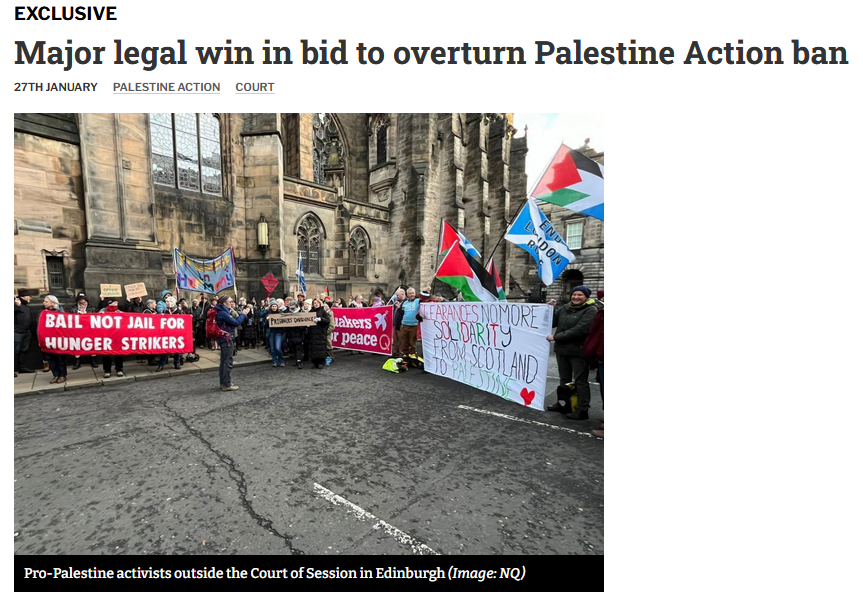


 | truthaholics