
After Advocating Ethnic Cleansing, Trump Feigns Concern for Palestinians While Pushing for Their Expulsion! #BDS

After Advocating Ethnic Cleansing, Trump Feigns Concern for Palestinians While Pushing for Their Expulsion | Quds News Network | QNN Team | 4 Feb 2025

Trump suggested that Palestinians have “no choice” but to leave their homeland.

Washington DC. (Quds News Network)- US President Donald Trump has renewed calls for the mass expulsion of Palestinians from Gaza, insisting they should be relocated elsewhere. Despite framing his proposal as a humanitarian solution, Trump repeatedly described Gaza as uninhabitable and suggested that its residents have “no choice” but to leave.

“The people of the Gaza Strip have no choice but to leave,” Trump said. “Look, the Gaza thing has not worked. It’s never worked. I feel very differently about Gaza than a lot of people. I think they should get a good, fresh, beautiful piece of land. We’ll get some people to put up the money to build it and make it nice.”

Trump dismissed the idea that Palestinians want to stay in Gaza, calling it a “pure demolition site” that is “unsafe” and “unsanitary.” He claimed that if given the opportunity, “they’d love it” elsewhere.

“They’re there because they have no alternative,” he told reporters. “What do they have? It is a big pile of rubble.”

Trump had explicitly called for neighboring Arab countries to take in Gaza’s population. “I’d like Egypt to take people, and I’d like Jordan to take people,” he said. “You’re talking about probably a million and a half people. We just clean out that whole thing.”

His remarks echoed previous statements in which he urged Israel to quickly wrap up its genocide on Gaza. Last year, he told Israeli newspaper Israel Hayom that he would have responded the same way Israel did after the October 7 military operation. However, he urged Israel to “finish up” its offensive and warned that international support was fading.

“You have to finish up your war. You have to finish it up. You’ve got to get it done,” he said.

Trump’s push for mass displacement aligns with statements made by his former senior foreign policy adviser, Jared Kushner. Kushner suggested that Israel should remove Palestinians from Gaza while it “cleans up” the besieged enclave.

“From Israel’s perspective, I would do my best to move the people out and then clean it up,” Kushner said, adding that Gaza’s “waterfront property” was potentially “very valuable.”

Trump’s remarks mark a continuation of his administration’s stance on the Israeli crimes, advocating for forced displacement while presenting it as a form of assistance.

_______
source
_______

______________

Alongside Netanyahu, Trump Says Palestinians in Gaza Should Be Removed ‘Permanently’ | Antiwar.com | Dave DeCamp | 4 Feb 2025

The president said Palestinians could no longer live in Gaza due to the destruction caused by the US-backed Israeli bombing campaign

Alongside Israeli Prime Minister Benjamin Netanyahu at the White House, President Trump said Palestinians should be removed from Gaza on a “permanent” basis.

“You look over the decades, it’s all death in Gaza. This has been happening for years, it’s all death. If we can get a beautiful area to resettle people permanently in nice homes where they can be happy and not be shot and not be killed,” Trump told reporters.

Trump’s repeated calls to “clean out” Palestinians from Gaza have raised fears that the US may support the ethnic cleansing of the territory, the ideal outcome for the Israeli government. Despite very strong opposition from Egypt, Jordan, and other Arab states, Trump has continued to double down on the idea.
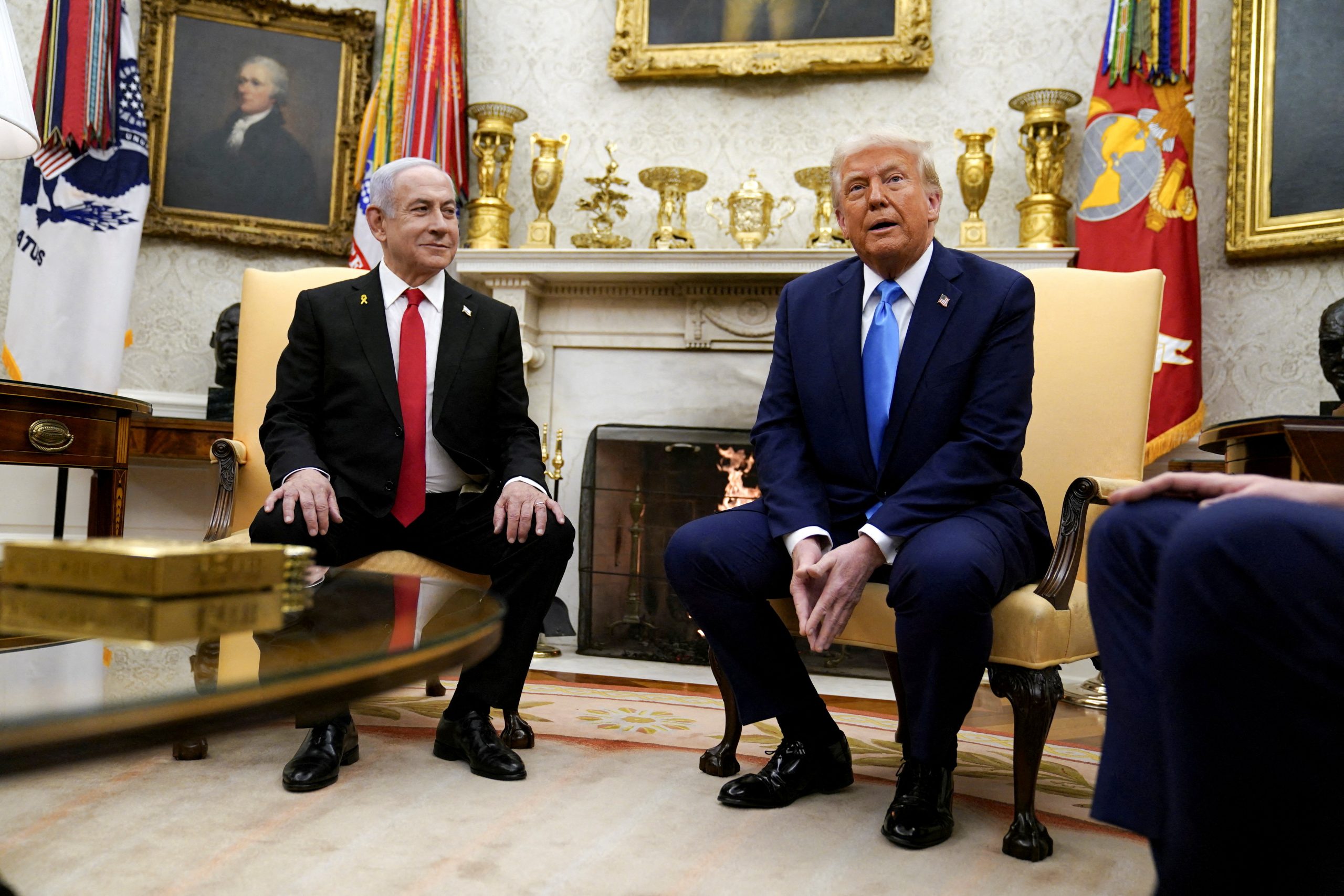
US President Donald Trump meets with Israeli Prime Minister Benjamin Netanyahu in the Oval Office at the White House in Washington on February 4, 2025. REUTERS/Elizabeth Frantz

Trump said at the White House that he believes Palestinians can be resettled in “areas where the leaders currently say no.” He said Palestinians could no longer live there due to the destruction caused by the US-backed Israeli bombing campaign and the threat of unexploded ordnances, among other things.

The president said repeatedly that the conditions in Gaza have been “like hell,” a result of the Israeli blockade that was first imposed on the Strip in 2007. “I don’t think people should be going back to Gaza. I think Gaza has been very unlucky for them. They’ve lived like hell, they’ve lived like you’re living in hell. Gaza is not a place for people to be living. And the only reason they want to go back, and I believe this strongly, is because they have no alternative,” he said.

When asked if Palestinians would have the right to return to Gaza, Trump said, “It would be my hope that we could do something really nice, really good, where they wouldn’t want to return. Why would they want to return? That place has been hell.”

Israeli officials have welcomed Trump’s idea, which has overwhelming support among Jewish Israelis, and frame what would be ethnic cleansing as “voluntary migration.” But since Israel has made Gaza uninhabitable, Palestinians who don’t want to leave might have no choice but to go for their survival if given the option. Not only have the majority of residential buildings in Gaza been destroyed, but the infrastructure has also been completely shattered.

Regardless of the living situation in Gaza, removing the Palestinian population would face significant resistance from Hamas, which has replaced the fighters it has lost in the Israeli onslaught, according to US intelligence. A Hamas official said on Tuesday that Trump’s proposal was a “recipe for chaos” in the region.

“Our people in the Gaza Strip will not allow these plans to pass. What is required is an end to the occupation and aggression against our people, not their expulsion from their land,” said Hamas official Sami Abu Zuhri, according to Al Jazeera.

Trump and Netanyahu met amid the fragile ceasefire in Gaza, and there’s a significant chance the genocidal war will restart as the Israeli leader is reportedly looking for US support not to implement the second phase of the deal. Netanyahu said his war goals still include the destruction of Hamas, which would be impossible if the full ceasefire deal is implemented.
_______
source
_______

| Opinion: US Exceptionalism is basically a Nazi Thing, Belarus leader says!

U.S. Exceptionalism Is Basically A Nazi Thing, Belarus Leader Says ~ BuzzFeed Staff.

“Not long ago black-skinned people in America were slaves. Today they make statements about some sort of exceptionalism,” says the man referred to as the “last dictator in Europe.”

Belarus’ President Alexander Lukashenko (C) salutes as he watches a military parade during celebrations marking Independence Day in Minsk July 3, 2013. Pool / Reuters

Alexander Lukashenko, the hardline leader of Belarus, has compared the idea of U.S. exceptionalism to Nazi ideology and criticized President Barack Obama for supporting it as a “black-skinned person.”

Lukashenko, once dubbed the “last dictator in Europe” by former secretary of state Condoleezza Ricetold a Kazakh television station that the idea of U.S. exceptionalism was “very bad” and “counterproductive.”

After issuing a sweeping statement of support for Syrian president Bashar al-Assad, Lukashenko slammed the U.S. for meddling in the affairs of Middle East countries.

He continued: “The American nation — it’s funny, I can’t even grasp what it is as a nation, this American one, which already awarded itself the right to some sort of exceptionalism. Do you know what that already smells of?” he asked an interviewer from Kazakhstan’s 24KZ channel.

“We already lived through this exceptionalism in the middle of the last century, and it cost 50 million lives. So it already smells of something bad,” Lukashenko said, referring to World War II. “So for a nation to award itself the right to some sort of exceptionalism…and as a result of this to ground the bombing of other governments is, I think, to put it softly, counterproductive. It’s very bad.”

“Putin was right when he said the the scariest thing is when this ideology of our exceptionalism, as Obama says, is hammered into the head of the population, and that’s 300 million people,” Lukashenko said of the U.S. “And they, as it once was in Germany, start thinking it’s a special race, a special blood, and a special exceptionalism and they should restore world order and bring everybody to their standards.”

Russian president Vladimir Putin called out “American exceptionalism” in a New York Times op-ed last month warning against U.S. intervention in Syria. “It is extremely dangerous to encourage people to see themselves as exceptional, whatever the motivation,” Putin wrote in the conclusion of the hotly debated op-ed.

Lukashenko continued by personally addressing Obama’s role in the concept: “Obama amazes — not long ago, black-skinned people in America were slaves. Today, they make statements about some sort of exceptionalism.”

“I never thought a person coming out of these poor conditions could put such a rhetoric into the world,” Lukashenko said. “It’s inadmissible. It’s very dangerous.”

_________________________________________________________________________

US Barb2

| Defining American Exceptionalism!

American exceptionalism ~ Wikipedia, the free encyclopedia.

American exceptionalism is the theory that the United States is different from other countries in that it has a specific world mission to spread liberty and democracy. In this view, America’sexceptionalism stems from its emergence from a revolution, becoming “the first new nation,”[1] and developing a uniquely American ideology, based on liberty, egalitarianismindividualismpopulismand laissez-faire. This observation can be traced to Alexis de Tocqueville, the first writer to describe the United States as “exceptional” in 1831 and 1840.[2] Historian Gordon Wood has argued, “Our beliefs in liberty, equality, constitutionalism, and the well-being of ordinary people came out of the Revolutionary era. So too did our idea that we Americans are a special people with a special destiny to lead the world toward liberty and democracy.”[3]

The specific term “American exceptionalism” was first used in 1929 by Soviet dictator Joseph Stalinchastising members of the Lovestone-led faction of the American Communist Party for the heretical belief that America was independent of the Marxist laws of history “thanks to its natural resources, industrial capacity, and absence of rigid class distinctions.”[4][5]

Although the term does not necessarily imply superiority, many neoconservative and American conservative writers have promoted its use in that sense.[1][6] To them, the United States is like the biblical “shining city on a hill,” and exempt from historical forces that have affected other countries.[7]

Since the 1960s, postnationalist scholars have rejected American exceptionalism, arguing that the United States had not broken from European history, and has retained class inequities, imperialism and war. Furthermore, they see most nations as subscribing to some form of exceptionalism.[8]

Notes

  1. ab Lipset, Seymour MartinAmerican Exceptionalism, pp. 17–19, 165–74, 197
  2. ^ de Tocqueville, Alexis. Democracy in America (1840), part 2, page 36: “The position of the Americans is therefore quite exceptional, and it may be believed that no other democratic people will ever be placed in a similar one.”
  3. ^ Gordon Wood, “Introduction” in Idea of America: Reflections on the Birth of the United States(2011) online.
  4. ^ Albert Fried, Communism in America: A History in Documents (1997), p. 7.
  5. ^The New American ExceptionalismDonald E. Pease U of Minnesota Press, 2009 ISBN 0-8166-2783-5ISBN 978-0-8166-2783-7 Length 246 pages p.10
  6. ^ The American Spectator : In Defense of American Exceptionalism “the conditions American Exceptionalism provides, allow us to enjoy the economic and social mobility that other countries envy.” and “progressivism rejects American Exceptionalism.”
  7. ^ Harold Koh, , “America’s Jekyll-and-Hyde Exceptionalism,” in Michael Ignatieff, ed., American Exceptionalism and Human Rights, p. 112
  8. ^ David W. Noble, Death of a nation: American culture and the end of exceptionalism, pp. xxiii ff.