
Boris Johnson’s Hard Brexit: Bannon, Epstein, Farage and Johnson and the Plot to ‘Topple’ UK PM Theresa May!

Boris Johnson’s Hard Brexit: Bannon, Epstein, Farage and Johnson and the Plot to ‘Topple’ Theresa May | Adam Bienkov and Peter Jukes | Byline Times | 16 FEB 2026

Newly-released messages between the far-right former Trump adviser Steve Bannon and the late convicted paedophile Jeffrey Epstein, reveal how Bannon worked with Boris Johnson and Nigel Farage to “overthrow” Theresa May at the height of the 2018 Brexit crisis in the UK.

The messages begin in the days following Boris Johnson’s resignation from May’s Government over her ‘Chequers Plan’ for Brexit and show Bannon detailing his attempt to help remove the then Conservative Prime Minister from office.

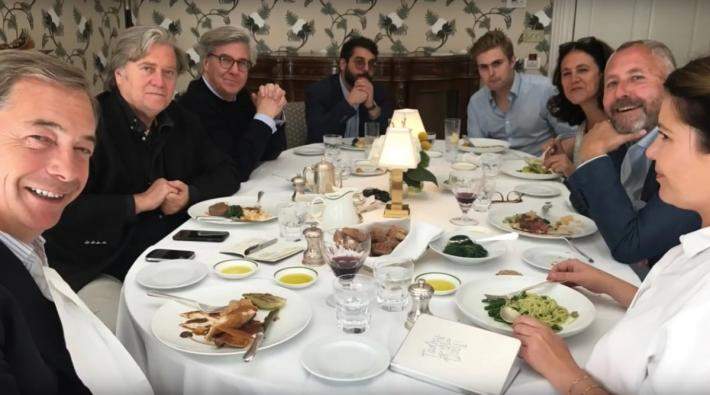
From left to right: Nigel Farage, Steve Bannon, Jeffrey Epstein and Boris Johnson

In one message on 16 July 2018, Bannon, who had established a London base in a Mayfair hotel where he met with prominent Conservative and far-right European political figures, tells Epstein that he is in “London with Boris”, while in another message three days earlier he tells him that “We are overthrowing May right now.”

Johnson strongly denied any such collaboration with Bannon or Farage at the time, with his spokesperson telling the Observer in June 2019 that “any suggestion that Boris is colluding with or taking advice from Mr Bannon or Nigel Farage is totally preposterous to the point of conspiracy.”

When questioned later by LBC about reports of his communications with Bannon, Johnson called the claims “the biggest load of codswallop I have ever heard.” 

A spokesperson for Johnson did not respond to a request from Byline Times for comment following the release of the Epstein messages. 

Bannon’s apparent involvement with Johnson began days after the then Foreign Secretary resigned from May’s Government, describing her Chequers plan as a “betrayal” of Brexit.

In unused footage from the 2019 documentary The Brink, Bannon is recorded telling the documentary makers that he had collaborated with Johnson “all weekend” on his resignation speech.
EXCLUSIVE: Dinner with Mr Brexit: Bannon’s European Revolution – Planned with Farage, Backed by Epstein Nigel Farage was the figurehead and his partner Laure Ferrari started it. Steve Bannon and convicted sex offender Jeffrey Epstein were providing almost daily support – Peter Jukes

“Today we are going to see if Boris Johnson tries to overthrow the British Government” he is filmed saying.

“He’s going to give a speech in the Commons. I’ve been talking to him all weekend about this speech. We went back and forth over the text”.

Bannon’s association with Johnson appears to have begun after Trump’s first election victory in 2016.

 “Right after we won [Trump’s first Presidency], Boris flew over,” he recalled.

“Because their victory was as unexpected as ours. I got to know him quite well in the transition period”.

Johnson appeared to return the interest, inviting Bannon’s controversial political campaigning company to two meetings at the Foreign Office’s Wilton Park base in 2017.

Previous Byline Times FOI requests for details about these meetings were refused on the grounds of US-UK intelligence and national security concerns.

Alison Klayman, who made The Brink, said that Bannon had been “unequivocal” about his ongoing communications with Johnson.

Other journalists picked up on the relationship. When Bannon was Chief of Staff in the White House, Johnson reportedly developed a natural affinity with him.

Anthony Seldon‘s Johnson at 10 book reported unnamed FCO officials describing Johnson and Bannon as “hitting it off” during this period — finding him both “intriguing” and “distasteful”— while ignoring repeated official warnings about Bannon’s far-right European connections. 

“Johnson was reminded by officials [that] Bannon had extensive contacts with the far right in Europe, but ‘it didn’t seem to concern him’ Seldon reported.

After Bannon was fired by Trump in 2017 the Mirror reported that Johnson remained in regular contact with him.


The ‘Movement’

This association continued, even as he befriended Epstein and used his connections and financial acumen to set up his European far right ‘Movement’ with Nigel Farage.

Bannon maintained the association with the then UKIP leader, the Epstein messages suggest.

On 15 July 2018, both men appeared jointly on the radio station LBC, during which they attacked May’s leadership.

Following their appearance, Epstein texted Bannon “Good work on LBC.”

Bannon continued to press for May’s resignation in the months that followed.

On 14 November 2018 then then Conservative MP Jacob Rees-Mogg MP submitted a letter of no confidence to the 1922 Committee chairman in May’s leadership, amid a wave of Cabinet resignations over May’s Chequers plan. 

Bannon texted Epstein describing the UK as a “hot mess” and explained: “I’ve gotten pulled into the Brexit thing this morning with Nigel, Boris and Rees Mogg.” Epstein replied, asking if May would survive; Bannon responded, “I don’t see how… Boris; Gove; Rees Mogg; David Davis – somebody has to step up.”
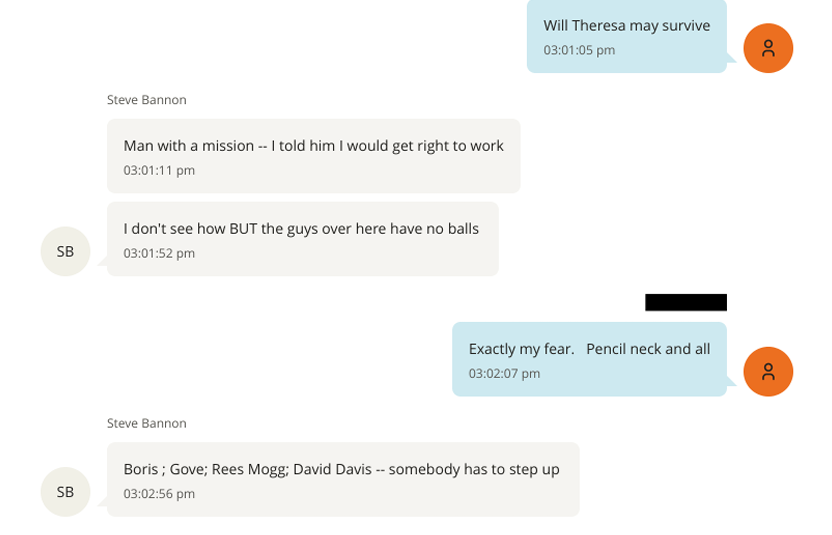
Messages between Steve Bannon and Jeffrey Epstein

The next day the Daily Mirror published a photo of Johnson and Farage sharing what was described as a “cosy chat” at a Belgravia restaurant alongside Johnson’s father Stanley, fueling speculation of a hard-Brexit pact.

A spokesperson for Nigel Farage was contacted for comment.

Bannon continued to claim to be working on May’s removal.

On November 16, Bannon told Epstein that he was still in London because “the guys are trying to move on May today / tomorrow and I’m having a meeting right now”. 

Epstein informed the prominent Norwegian diplomat Terje Rød-Larsen that Bannon would not be able to meet up in Abu Dhabi because he was staying on in London “at the request of Boris Johnson”. 

Bannon agreed with Epstein that he should stay as long as possible in the UK “so people get the commitment of your follow through”. 

Journalist Michael Wolff separately emailed Epstein, positioning himself as an “intermediary with leadership challenger Boris Johnson.”

A month later, in mid December, Bannon appeared to still be involved, texting Epstein that May was struggling and that he could “get Boris across the finish line”.
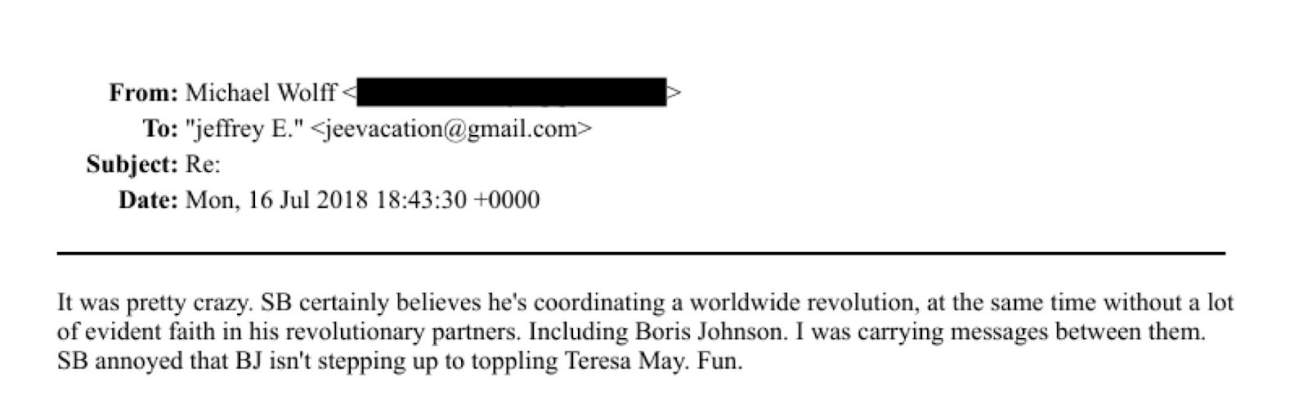
Email between the journalist Michael Wolff and Jeffrey Epstein

Bannon texted Epstein that May was struggling and that he would soon “get Boris across the finish line”.

May would finally resign the following July, paving the way for Johnson’s elevation to Prime Minister.

The Epstein messages reveal a shared long term interest with Epstein in the long term project of securing a hardline form of Brexit, which May was perceived as being a barrier to.

In the days following the 2016 EU referendum, Epstein had emailed another associate, Palantir founder Peter Thiel, describing Brexit as “just the beginning” of “a return to tribalism, counter to globalisation, amazing new alliances.”

The Epstein files reveal in clearer terms than ever before, just how far those alliances extended.

_________
source
_________


Selling Out Fair Play: UK Labour Party has lost our Trust so what else now but Vote Independent?

The Labour Party has lost our trust so what can we do? | Mike Sivier | Vox Political | 18 Mar 2025

The Labour Party has lost our trust so what can we do?
Can another party of the Left arise in time to make a difference?

For many people, the end came with Liz Kendall’s betrayal of Labour’s contract with people who don’t have a job and cannot work.

Despite what its ministers have been saying lately, Labour is not the Party of Working People – it should be the Party of Working-Class People, in whatever capacity they currently exist.

I went back and looked up the party’s founding principles, when it was originally formed in 1900 by trade unions, socialist groups, and cooperative societies to represent the working class in Parliament.

Buy Cruel Britannia in print here. Buy the Cruel Britannia ebook here. Or just click on the image!

Its core founding principles were:

Representation of Labour Interests – Giving political voice to the working class, particularly through trade unions;

Social Justice – Advocating for fair wages, workers’ rights, and better living conditions;

Public Ownership – Supporting nationalization of key industries and services;

Democratic Socialism – Balancing socialist ideals with democratic governance; and

Equality and Welfare – Promoting policies for social security, healthcare, and education.

As you can see (because I have italicised them), the party exists partly due to a will to create better living conditions for working class people with policies for social security, among its other purposes.

Liz Kendall’s announcement about sickness and disability benefits betrays that purpose because it deliberately undermines the living conditions of working class people by removing the social security safety net.

She might say she is preventing abuse of the system by malingerers, but the bald truth is that there aren’t any malingerers who are abusing the system – or at least, not enough to justify changing the benefit system to push them out.

So it’s another big lie.

And in any case, we know that the top one per cent of wealth owners have profited massively from the last 14 years of Tory rule – and the last 46 years of neoliberal ideological ascendance. They are the prime group for plunder, if Labour politicians need to extract money from a particular group.

Not only does it help relieve the huge disparity between the wealth of the billionaires and the poverty of the poorest, but it inflicts far less harm; benefit claimants have to spend all their money, simply to survive, while the super-rich would not feel any decline at all in their living standards, if one per cent of their enormous wealth was taxed off them.

And that’s a third big lie.

I don’t want to support a party of liars. Do you?

Maybe you hope the party could reclaim its original purpose with different leadership?

Not without difficulty. The party stepped back from centrism/neoliberalism under Jeremy Corbyn, focusing on wealth redistribution, public ownership, and protecting the most vulnerable – but there was a huge pushback from the Establishment, using the mass media, with a concerted effort to portray him as an anti-Semite in the face of facts that clearly showed he was the opposite. Remember?

Buy Cruel Britannia in print here. Buy the Cruel Britannia ebook here. Or just click on the image!

The way Corbyn was vilified illustrates how deeply entrenched neoliberalism has become in UK politics, with the Establishment—including the mainstream media, corporate interests, and even many within Labour itself—fiercely resisting any challenge to their dominance.

And Keir Starmer spent years purging the party of anybody with left-wing leanings, replacing them with more neoliberals like him. Any left-wing resurgence would be met by similar resistance and if he were to step down for any reason, he would certainly be replaced by a clone.

But Labour’s day is done.

Sure, the party won a landslide at the 2024 election but with a dramatically reduced number of supporters, it was arguably a victory by default rather than genuine enthusiasm—more a rejection of the Tories than an endorsement of Starmer’s vision.

Labour had lost the confidence of left-wing voters. They are now looking for a new political home.

Mr Corbyn is now the nominal leader of a left-wing Independent group in Parliament, and more politicians are going Independent all the time. This suggests that the left in the UK isn’t disappearing—it’s just looking for a new vehicle.

The challenge, of course, is that the electoral system makes it incredibly difficult for independents and smaller left-wing parties to gain power at scale. But if enough MPs break away and grassroots movements continue to grow, there’s a real possibility of a more substantial left-wing alternative emerging outside of Labour.

I have a few ideas about the form such an alternative might take – but that’s a story for another article.


_____
source
______

ALSO SEE:

A Very Short History of the Labour Party | Ed Selkirk Ford | The Constitution Society | 4 Dec 2024

“Given the many groups who are part of Labour’s coalition, attempts at structural reform are likely to continue. However, given the bitterness of factional infighting, and the huge reputational costs that such navel-gazing imposes, particularly on a party in power, Labour’s leadership and activists alike would be well advised to let these matters rest for the moment. The status quo won’t hold forever, though. As society and politics continue to evolve, so too does the broad and frequently unwieldy political coalition of the Labour Party. The history of the Labour Party is a modern history of British politics, and one which remains unfinished.”


History of the Labour Party (UK) | Wiki

The Labour Party’s origins lie in the growth of the urban proletariat in the late 19th century and the extension of the franchise to working-class males, when it became apparent that there was a need for a political party to represent the interests and needs of those groups.[4]

| Dissing Tony Benn!

Dissing Tony Benn ~ Matt Carr’s Infernal Machine.

Rarely has the death of a major politician generated such faint and often blatantly hypocritical praise as the tributes and obituaries dedicated to Tony Benn. In general the response has been dominated by broadly similar motifs; that Benn was ‘charming,’ ‘charismatic’, a ‘great speaker’ and a ‘conviction politician’  with strongly-held principles and beliefs – accompanied by the unspoken or sometimes overt caveat that these beliefs were naive or wrong-headed, and that in any case the person praising him for having them didn’t and doesn’t share them.

We know that Cameron doesn’t share them, so there is nothing surprising about  his patronizing observation that ‘ There was never a dull moment listening to him, even if you disagreed with him.’   Or Nick Clegg’s description of Benn as ‘A towering figure in British politics and a fervent defender of what he believed.’

Benn’s former colleagues in  the Labour Party have made similar observations.   Thus Margaret Beckett observes that ‘People may or may not agree with him but they would come out of a public meeting he had addressed saying “I didn’t agree with any of it, but it was wonderful”.

Ah bless.   And then there is Ed Miliband observing that ‘Whether you agreed with him or disagreed with him, everyone knew where he stood and what he stood for.’

That’s certainly not something you can say about Miliband.  Benn remains an uncomfortable and anomalous figure for the Labour Party: a democratic socialist and political radical who was genuinely popular;  an activist/politician who believed in trade unions and regarded working men and women as protagonists of history rather than objects of focus groups; who opposed the war in Iraq, who stood up for the rights of Palestinians, who supported nationalisation and public ownership.

For years the Labour Party has based itself on moving away from most – if not all of these ideas and projects,  and its leadership is still terrified of being associated with them.  Therefore to depict him as a charming speaker who you could spend a pleasant evening with listening to amiable but ultimately wrong-headed beliefs is both a distancing mechanism and an overt or covert rejection of those beliefs.

Some Labour figures have gone further.  In the IndependentDavid Blunkett describes himas ‘ charming, persuasive, and deeply frustrating who ‘missed his chance to make a real difference’ when he was in government and represented a period when ‘Labour was still stuck in a bygone era, ceding the intellectual high ground as well as failing to relate to the very electorate Tony genuinely believed he spoke for.’

Then there is ‘Baroness’ Shirley Williams, one of the founders of the SDP, similarly claiming that ‘Tony was yearning for a world that was gone.  He didn’t really recognize that the world was becoming global.’   And on Channel Four News yesterday, Polly Toynbee, another of the SDP’s founding members who left Labour because of Bennism, described his influence on the Labour Parrty as ‘ catastrophic’ and essentially blamed him for keeping the Tories in power for the best part of two decades.

In 2011 Toynbee described Benn in 2011 as ‘ a ruthless destroyer now curiously regarded as a charming national treasure.’   Like many of Benn’s critics,  Toynbee accused Benn of having made Labour ‘unelectable’, even though it was the formation of the SDP that split the Labour vote.

Media guests invited to discuss Benn also appear to have been chosen to reflect a similar view of Benn’s influence and legacy.   Few of them have come from any further left than Diane Abbot.   On BBC news today, Alison Phillips, weekend editor of the Daily Mirrorcould be found accusing Benn of having ‘ caused all sorts of problems for the Labour Party’ in the 70s and 80s.

Bad Benn.   And yesterday’s Guardian obituary – co-written by arch Blair acolyte Patrick Wintour –  included this stunningly poisonous nugget:

‘Some old ministerial colleagues from the 1970s and 80s privately made plain they would be making no public comment, reluctant to speak ill of the dead. But bitterness against what they still see as his destructive and dishonest conduct during the Bennite ascendancy remains toxic.’

It is difficult to imagine the Guardian ever saying something like this about any politician, let alone a Labour politician.  ‘Dishonest’ and ‘toxic’ are not words that Wintour or the Guardian are ever likely to apply to Tony Blair.

But Benn is clearly a figure who still needs to be put in his place, and not only by his former party colleagues.  There was a time when the rightwing press vilified Benn for his support for nationalisation and public ownership, when he was ‘the most dangerous man in Britain’ and the Daily Express drew cartoons showing him in a Nazi uniform.   Even today, despite his evolution into an avuncular, pipe-smoking radical, historian Dominic Sandbrook was still claiming in the Daily Mail yesterday that Benn would have transformed Britain into ‘North Korea.’

Even in death it seems, Benn is an uncomfortable figure for a political and media establishment that is determined to present anything and anyone with the faintest whiff of socialism as backward, reactionary and dangerous.

This discomfort is particularly apparent amongst the hollow, manufactured politicians, careerists and closet neocons who dominate the Labour Party, perhaps because  Benn remained true to his principles when so many senior Labour Party figures were doing the exact opposite and picking up peerages and lucrative directorships with private companies and corporations as a reward for doing so.

I remember him very well during a brutal night at the Wapping picket in 1986.   Benn was speaking from a small stage in the fenced-in field opposite the News International building when mounted police charged the audience in a totally unprovoked attack.  It was a terrifying experience to be hemmed into that densely-crowded field, with visored cops swinging truncheons at a crowd that had been peacefully listening to speeches.

I remember Benn calling for an ambulance from the stage because someone had had a heart attack, while the police horsemen roamed the field cracking heads.   This mayhem was quite routine, but it was never condemned and rarely even mentioned in parliament or the media.

I don’t recall any other senior Labour politician who went anywhere near Wapping throughout the year of the strike.  Then, as now, trade union struggles were something to be avoided, by a party that had already embraced the essential tenets of Thatcherism in order to make itself ‘electable’ and has continued to do so ever since.

Even then, it was obvious that Benn was different.  In the years that followed he remained a tireless and ubiquitous figure in the extra-parliamentary left who was always present in every popular movement, every demonstration,  and every popular mobilization, the living embodiment of the British socialist tradition of Blake, Robert Owen, William Morris, Keir Hardie and Nye Bevan.

That is a tradition that the Labour Party has long since distanced itself from,  and despite the crocodile tears that have been shed over him in the last two days, it is difficult to avoid the feeling that many of those who are queuing up to pay their respects have come, like Caesar’s mourners, to bury and not to praise him.

Benn1

| Time to abolish the UK’s last “rotten borough” – the City of London Corporation!

Time to abolish the UK’s last “rotten borough” – the City of London Corporation ~  JOHN MCDONNELL, New Statesman.

One year on from the Occupy protest at St Paul‘s, we’re no closer to reforming the dark heart of predatory capitalism.

On the night Occupy LSX marched into the City tweets came into me asking for help as the police kettled activists on the steps of St Paul’s. I went down there and did what little I could to prevent people being roughed up. Over the next few days the tents soon appeared and the occupation became a debating forum on the causes and creators of the economic crisis.

As days turned into weeks and the cathedral hierarchy split over whether to evict the camp, the occupiers soon discovered the existence of an organisation the vast majority of the population barely knows exists. The City of London Corporation was flushed out of the shadows in which it normally lurks to show that it was something more than the organiser of a good pageant in the Lord Mayor’s Show.

Naturally members of Occupy turned their inquisitive attention to this seemingly quaint body that was threatening to send in the bailiffs. Just as the direct action by UK Uncut transformed the issue of tax evasion from a dry debate for accountants into a popular cause, Occupy has helped turn the spotlight on the abuse of power that is the City Corporation.

In Michael Chanan’s and Lee Salter’s new film, “Secret City”, Maurice Glasman explains ironically that St Paul’s was the site of our earliest democracy, where the citizens of London in medieval times would hold hustings. In the sixteenth century the city took over from Amsterdam as the centre of international credit and maritime trade. Its coffee houses became banks and governments became dependent upon them for loans, largely to finance wars.

Government’s reliance on the city to finance the national debt gave the city such influence that the Corporation was able to avoid the successive reforms that established democratic local government in the rest of the country.

Instead the City Corporation to this day retains the business vote, which overwhelms the votes of residents in the elections for its Common Council. The vast proportion of elections in the City have not been contested. Instead an old boys’ network amongst the companies sorts out which favoured son is to be bestowed the seat.

This usually prevents anyone slipping through the net who shows any spark of independence, although not always. Around a decade ago, Malcolm Matson was elected with 80 per cent of the vote but was known to favour reform. He was hauled before the City’s Court of Aldermen and was blackballed. Local vicar, the William Taylor, was also successful in being elected but as soon as he started asking questions about the Corporation’s unpublished accounts, his bishop received letters with more than a hint of a threat.

Matson and Taylor could not be tolerated because they were asking questions about the massive resources being spent on the secretive role the City Corporation plays as the lobbyist for finance capital. The Corporation has used its influence to dictate successive government’s policies on the regulation of finance and taxation.

This secured the deregulation of the “Big Bang” era of Thatcher and the hands off approach under Blair and Brown. City speculators were allowed to create the bubble that eventually burst to create the current economic crisis. London became a funnel through which trillions poured into tax havens and the concentration on financial speculation rather than investment in our manufacturing base unbalanced our whole economy. Obscene levels of incomes and conspicuous spending in the City have also created a society grotesquely scarred by inequality and a capital city in which immense wealth is located cheek by jowl with stark levels of poverty.

It was Labour Party policy since its foundation to abolish the City Corporation, until Blair arrived and the policy changed to reform. The City cynically interpreted reform as simply giving more businesses the vote.

The abolition of this last “rotten borough” would show that Ed Miliband is serious about tackling predatory capitalism.

John McDonnell is the Labour MP for Hayes and Harlington

“Secret City” previews at the House of Commons on Tuesday 16 October. For details of screenings and to watch a trailer for the film, visit: secretcity-thefilm.com

__________________________________